Archive for the ‘open source’ Category
CUNYfying Uses of Technology
December 5th, 2016
[This is the keynote address given December 2nd at the 15th Annual CUNY IT Technology Conference. If you click on the image you’ll get the publicly posted Prezi presentation in a separate window. The headings and other text in blue type will indicate when to advance that presentation, if you want to use it.]
CUNYfying Uses of Technology
The title may call for some unpacking. The whole talk is about what I mean by CUNYfying, so we’ll see how I do; I hope it will come to seem more than an awkward pun. Since my bag is academic technology – technology used in the service of our core mission of teaching and learning – that’s the technology I’ll focus on for the most part. By growth, I mean not just increase in size but progress– moving forward as well as getting bigger. And by what’s in our DNA, I mean that our opportunities are what they are because we are a genuinely unique system, in situation, in mission, in prospects.
Who We Are & What We Have
I think any talk about CUNY should start with a map. (This is one in a series by Michael Dorsch of the Futures Initiative, about which I’ll be saying more later.) We can talk about how big we are (only Cal State & SUNY are larger), but the truly unique thing about us, what sets us apart as a university system, is how close we are. No other system comes close to our closeness.
The Shared Landscape
That closeness is not just geographical proximity. As Chancellor, Matthew Goldstein advanced the theme of the Integrated University, part vision, part realized promise. I want to look at some aspects of that – common systems and a Common Core as well as the Commons; a way to take in what is offered, even and especially if you’re a student: a level playing field in terms of bandwidth and access (fully in place this very academic year); a movement from locked down licenses and siloed services to shared apps and shared services.
Why This Is Important — In the Abstract
Harvard prof Jonathan Zittrain (in The Future of the Internet – And How to Stop It) came up with his 5 Aspects of Generativity as a way of navigating between two dystopian extremes: a corporatized, locked-down ‘net on the one hand, and one where malware and misrule have sway, a kind of wild west of the web. The middle way is one of general, mutual, palpable benefit – uses and practices that are also motivations for following them that are leverageable, adaptable, easy to master, accessible, and transferable. Instruction and communication in particular move from presentational to the collaborative, from the static and established to the flexible and evolving, from the top-down hierarchical to the shared and democratic, from siloed programs and practices to rich integration and collaboration. Motivations for adopting and adapting become self-driving and truly generative.
Examples of Incubated Innovation
Maybe that’s a little abstract. So let’s look at some examples, incubated projects that became project incubators – examples of what I mean by generative.
The Commons
First and foremost is the CUNY Academic Commons, launched in 2009 and directed by Matt Gold and a team of real wizards, notably lead developer Boone Gorges. They’ve created a platform for social activity that knits the work and the people of CUNY together. It is the single most successful academic social network based at any university. Now with almost 10 thousand members and over 750 groups, the Commons is, as its name suggests, an open marketplace of activity and ideas – an open source platform (actually a kind of mash-up of open source technologies) informed by an ethos of openness. Anyone can look at almost anything—and, if you’re CUNY, you can join in. Matt Gold has suggested that one of the most important principles of the Commons is serendipity – the chance discovery of that person or group that will take what you’re dong to the next level.
The CUNY Games Network
is an example of this. The answer to the question implicit in the headline of the edtech newsletter Edsurge “How Did Four Community College Professors Spawn the CUNY Games Network?” is “They used the CUNY Academic Commons”: a few faculty interested in educational games founded a group on the Commons. The CUNY Games Network could be searched for and joined. That may sound like no big deal until you realize how many different kinds of people and skills sets educational gaming take: you need people interested in design, in coding, in animation, in pedagogy, in so many things – and they’re likely to be scattered all over the place in terms of campuses and disciplines. Within a year or so of finding each other, the CUNY Games Network (now 169 members strong) was sponsoring conferences (which they insist on calling games festivals), securing platforms for the building and deployment of games, building advising teams to help those new to gamification. This is beyond anything mere proximity could make happen. And it is clearly, truly generative.
Commons In A Box
Talk about generative: the Commons began to breed. With the success of the Commons, the development team (presumably because they didn’t already have enough to do) created Commons In A Box, or the CBOX project, and preconfiguration of open source tech like WordPress and BuddyPress, replete with themes, plug-ins (many of them of CUNY’s own devising, like email notification of posts & activity). It has been downloaded about thousands and thousands of times. There are over 500 installations up and running. The CBOX showcase gives a sampling the institutions and organizations using CBOX. I was long an admirer of the SUNY Learning Network, so I love that the SUNY Learning Commons is a CBOX installation. The MLA Commons — built by the Modern Language Association, the largest academic professional organization in the world — is a CBOX installation. One of my favorite SF authors, Neal Stephenson, is involved in a project called Hieroglyph that brings scientists together with science fictionists to imagine hopeful futures. It runs on a CBOX. Amazingly cool. Amazingly generative.
Academic Works + The Commons
The Academic Works project is the Institutional Repository for CUNY, managed by the CUNY Office of Library Services and the CUNY librarians and called for by a resolution of the CUNY University Faculty Senate, created to preserve and disseminate faculty research such as articles and conference presentations; educational materials that can be shared with students and colleagues; student theses and dissertations; CUNY’s scholarly journals,; and so on.Academic Works makes these more discoverable, more secure, and above all freely accessible. There’s a map of the world at the bottom of the home page where you can watch the downloading of publications from all over the planet in real time – more than a quarter million this year. I have one article (co-authored with Matt Gold) downloaded over 800 times (because it’s co-authored with Matt Gold; still, very cool).
Now imagine that connected to your profile on the CUNY Academic Commons, which is just one aspect of what the OLS and the CAC teams have been doing with a planning grant from the Sloan Foundation. The plan is to join the IR’spreservationcapacity and searchability to the social activity of the Commons. They share an ethos of openness, but in other ways they quite different. Standalone IRs tend to be static; things can just sit on the digital shelves. Social networks tend to get focused on the moment at the expense of what’s gone before, the best of what’s been thought and said. We have a chance to combine the preservation and taxonomic organization of the IR with the intensive social interaction of the Commons – so individuals point others to resources, create study and discussion groups, and who-knows-what-else. This will be something quite new – and quite CUNY.
Something else that is quite CUNY – CUNY Advance
The coinage is Ann Kirschner’s – she’s the former Dean of Macaulay Honors College, now Special Advisor to the Chancellor — but the fairy dust (money) came from Allan Dobrin, until recently our Executive Vice Chancellor for Administration. He wanted us to do cool things with ed tech — things he would, within reason and fiscal constraints, provide the wherewithal for. So if the ethos of the CUNY Academic Commons is openness, that of CUNY Advance is support. It does not begin with ideas — I should stress this — but seeks them out, understanding that innovation is distributed while resourcing tends to be centralized. One way of doing that was the CUNY Innovation Survey that Lisa Brundage, Director of CUNY Advance, put together. It really is wonderful – every campus and (if feels like) every possible use of ed tech seems to be reflected, but we had to ask people to fill out a survey, so there is no doubt a lot more out there than we haven’t captured.
Science Forward
One beneficiary of CA support is an interdisciplinary approach to science semi-simultaneously piloted at Macaulay and Hostos called Science Forward. The point was to rise above introductions of specific disciplines to delineate scientific ways of thinking (the science senses). The cornerstone of the project, the part CUNY Advance supported, is the Science Forward Video Series: over a dozen high quality videos that are both rich and accessible, specific and interdisciplinary, featuring CUNY scientists – and open to anyone to use.
Science Sims
With the understanding that visualizations support learning, especially in certain learners, Science Sims is a project devoted to science simulations. The twist is that they are built by students. Here are just the Math sims from the full catalog of sims. The site notes that many simulations are old, and look like ‘90’s video games. “These sims are fresh – built by students using modern javascript libraries. Sure, one day, they too will be old–but that day is not today!”
Flipped Gen Chem
The oldest, biggest, and greatest of the CUNY Advance projects just two weeks ago won, at the Online Learning Consortium Conference, the OLC Digital Learning Innovation Award. These are the slides showing the results that (I think) clinched the award. They’re the results of an approach where all the instructional content is delivered online, then students meet once a week to do problems, ask questions, compare notes. The results are for repeated offerings of courses across multiple campuses using the same tests and often the same professors. So the comparison is not just between the Traditional (TR) and Flipped (FL) approach but between strikingly different demographics that lead to a 40% difference in the student success rates. And see what the Flipped approach does? (Note the blue rectangles.) It effectively erases that difference. It doesn’t just bump up success 15% over traditional even where students are stronger. It takes the students who couldn’t succeed and shows them how to. And it does this when the students and tests are the same, with huge Ns and over repeated terms.
The project, led by Pam Mills and Donna McGregor (formerly of Hunter, now of Lehman), began with an epiphany. Teaching in sections of 1000 students or more, they realized they could do this better online – that it was already a kind of distance ed. But realizing that was just the beginning. They threw out the textbook, and they designed the course from scratch on pedagogical principles of scaffolding, self-pacing, constant assessment. The Commons team built a platform to their specifications – this was a case where technology was not a box we fit the course into, but a reimagined pedagogy that defined the box. That’s one reason I should stress that the full title of the OLC DLIA (already long enough) is the Faculty-Led DLIA. Pam and Donna believe they hit on principles that apply to all STEM instruction. If you are involved in that, I would talk to them. Make this even more generative.
Online Courses and Global Search
We can’t all be Pam and Donna, reinventing courses and pedagogy from scratch and defining customized platforms, but a lot of us can benefit from innovations (and, yes, shared landscapes) that were seeded long ago and might, just might, be coming to fruition now. I got the title of Director of Instructional Technology back in 2001 because we needed PI for a generous grant from the Sloan Foundation. We promised a couple hundred online and hybrid courses and not just hit but nearly almost trebled those targets. We got another 4-year grant and did more. And we evaluated the heck out of those courses. Students reported that interaction with their instructors was twice as high as in traditional courses, that interaction with their peers, 3 to 5 times as high. They thought they learned more, they thought they worked harder, and they wanted to do it again. (The instructors said the same thing, which clinched it for me.)
A sidebar: That Director of Instructional Technology title changed to University Director of Academic Technology in 2008 (why? Slight pay raise, plus and acknowledgment that that Academic Tech takes in things – digital scholarship, IRs, etc. – that aren’t strictly instructional). Either title guarantees one thing: you get bombarded by vendors. So I have a boilerplate response. It begins “You are confusing me with someone with staff and a budget.”
But CUNY gets a two-fer from me. In 2008, I became CAO of a school—the CUNY School of Professional Studies– that now has more than a dozen online degrees, with more on the way. Because it’s amazing what you can do with staff and a budget. That’s just at SPS. (I have to give a shout out to the school that’s our host: John Jay has a bustling, burgeoning online program, with its own online degrees and programs—and more on the way.) Back to SPS. Because 8 of its online degrees are bachelor’s degrees– by the way, ranked by US News & World Report in the top 5% of all online bachelor’s in the country (and #1 in NYS)—we had to build an online General Education curriculum. Something interesting happened afterwards: University-wide Gen Ed reform, with at least the prospect that all courses are generally transferable.
Remember: transferability is that one of the five aspects of generativity. Let’s think how that might work, not abstractly, but practically. First, there’s a ready-made online Gen Ed curriculum, so any school can now build a fully online undergrad degree with just the courses in the major – do 15 or so online courses, and you have an online degree. Second – but likely more important with Gen Ed accounting for more than a quarter of all undergrad course work, online Gen Ed means a lot of courses students could take to advance their academic progress, a lot (here’s the key) that might fill out fuller schedules if some of the courses could be taken online, guaranteed to fit any schedule as long as students take the time to do the work. Right now, a third of our undergraduates are part time – how much could we move them to full-time and get them across the finish line faster with the option of online courses?
Of course they’d have to be able to find them. Enter Global Search, a tool built by a crack CIS team led by Zev Jeremais and Youngren Ponnuraj and just launched in July. It allows any student to search by across institutions by course title, type, general ed category, mode of delivery, and so on.
What This Can Mean
Basically, we have an accelerator. What it accelerates is first and foremost degree completion. This in itself builds enrollments on the established and hardly counter-intuitive principle (the term in the research is academic momentum) that students who earn credits and satisfy degree requirements more quickly not only move faster through the curriculum but are retained at a much higher rate(because less likely to fall by the wayside). So this “accelerator” can retain and accommodate more students, while making things easier for faculty as well as students in a University where everyone commutes. It can extend outreach and capacity without building new buildings even as it raises reputations and profiles. Think about an online MBA at Baruch might mean, for instance, or an online Cybersecurity degree at John Jay. (I know they’re thinking about it.) Think about what extended reach combined with relatively low tuition can mean for CUNY schools generally.
CUNYfying, then, means…
First of all, further realizing and enhancing the core mission of CUNY, of access and/with excellence. I am a little distrustful of that latter term. Like Quality in Zen and the Art of Motorcycle Maintenance, it’s difficult to define. But I think we can all get behind a near-synonym we can actually point to and measure: student success — getting students through, getting them degrees, readying and not just credentialing them for the world as it is now. I think we are poised to do that better than ever.
Realizing the virtues of closeness (synergy is another word I don’t quite trust) means understanding closeness is not identity. Unlike Penn State, which also has 24 campuses but the slogan “One University geographically distributed,” we don’t all represent different points of access for the same curriculum. We are a federation of campuses with different constituencies and different purposes but lots of overlaps. That’s a good thing because I believe less in redundancies than richness and reinforcement, less in conflicts than complementarity. But what’s really good about closeness not being identity is what closeness then leads to:
- Innovation, bred by difference, comes from the edges not the center (the more fringe the better); it bubbles up rather than trickles down
- Incubation. If you want more than random acts of innovation, you need to incubate (support) –incubate, not impose University-wide adoption, but to nurture to maturity
- Dissemination is the next step—etymologically that is spreading the seed, and, by extension, letting it take root and give fruit in different ways at different places
- Collaboration is the key – collecting and conferring on effective practices that vary by context and constituency – and making those visible (closeness is sharing) –
Because I’m feeling that I’m getting abstract again, let me show you an example of what collaboration can look like, and how much difference it can comprise. Cathy Davidson (keynoting this conference 2 years ago) started the Futures Initiative here at CUNY and one of its first fruits was a course on Mapping the Futures of Higher Education that was actually a network of courses – applications of new pedagogies and technologies and shared practices and compared notes across more than a dozen courses, disciplines, and campuses – where else but in CUNY?
The thought to leave you with:
The goal is not to catch up but to leapfrog*
*Not to get to where everyone else is (or is trying to get to) are but to go beyond them in our own way
not parity, but integrity*
*not to be on the same page with everyone else but to write our own story
To our own selves be true.
The Problem(s) with Innovation
May 12th, 2014
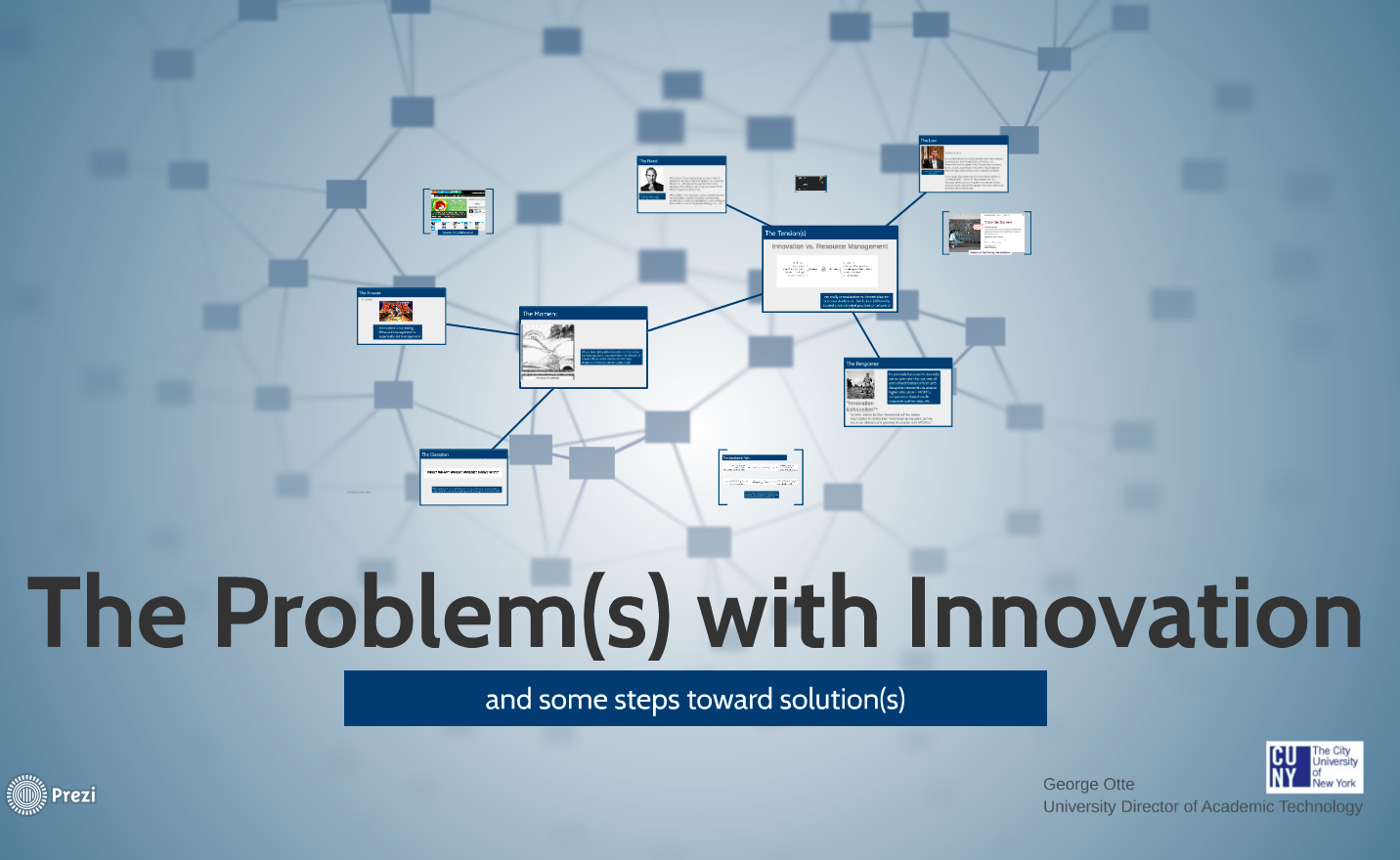 [This is my keynote at the Bronx EdTech Showcase on 5/9/14 — (reconstructed) text of the talk here,with access to the slides by clicking on the image. The upper-case headings are also slide titles — so, should you want to see the slides while reading the text, those headings will signal when to go to a new slide.]
THE PROBLEM(S) OF INNOVATION
I feel I need to justify the title a bit. I’m coming to you with problems? What’s that about? First of all, since all you folks are innovators, let me say that you are not the problem(s). On the contrary.
But if I ask how many of you feel as noticed and supported and impactful as you’d like to be, you’re probably aware of something we might call the problematics of innovation. More on that directly.
Second, this is not just an exercise in problem definition. I do want to get on to some steps toward solution(s). But it is better to define a problem before trying to moving on to a solution
So the Problem(s) with Innovation can be traced to a larger institutional problem — the reasons innovation doesn’t take hold are also the reasons institutions are notoriously slow to change.
I won’t deny for a moment that we are talking about complicated dynamics (or lack thereof) , but I’m a great believer in simplifying (if not oversimplifying).
THE TENSIONS
So one way of looking at the problem(s) is to realize that we are dealing with a set of tensions — specifically, tensions between how innovation percolates up and how resources filter down.
Basically, we are talking about tensions between innovation being centrifugal and resource management being centripetal.
Innovation happens at the edges, is dispersed, scattered, disruptive because it happens outside of the established status quo.
Resource management is top-down: organized hierarchically, in clear chains of responsibility and control, subject to audits and so highly documented and monitored. (Anyone tried to get a purchase requisition through lately?)
Admittedly, there’s nothing especially revelatory about seeing that ideas and money don’t flow the same way.
What’s worse, looking at it this way can induce apathy and even despair.
If we are going to think of what, if anything, we are going to do about this situation, we need to get to the bottom of these tensions.
THE QUESTION
WHO? WHAT? WHEN? WHERE? HOW? WHY?
The famous journalistic questions are supposed to help us analyze situations, but here I think they’ll just get us lost in the weeds. It’s time for simplification again. The key question is WHY? If these are differently motivated (as well as differently located) behaviors, what motivates them?
THE ANSWER
In a word, RISK.
- Innovation is all about taking risk. It’s being experimental, trying things out, testing hypotheses, being able to fail, revise, re-try.
- Effective resource management is risk avoidance. Resource management is essentially risk management.
The question is what happens when risk avoidance becomes risky.
THE MOMENT
It’s worth dwelling on the picture on this slide for a moment; it’s about Education, a bridge over Ignorance, and “Safety First” leads to the Road to Happiness.
Playing it safe might have been the Road to Happiness in 1914, but not in 2014.
The argument could be made that we have reached a game-changing moment when the most dangerous thing you can do is play it safe.
THE NEED
There’s an interesting analogy with not just what Steve Jobs said but what he was facing when, confronted with what seemed like insurmountable problems, he said ““The way we’re going to survive is to innovate our way out of this.” This was after he’d been kicked out of then brought back into Apple, post-bubble (and mid-recession, if not the Great Recession), with a sense that the excitement had gone out of technology while the pricy-ness and corporatization had escalated. In that crucible, we got Mac OS, the iPod and iTunes, the iPhone and iPad, IOS, and so on.
Jobs was not himself an innovator, of course, but he was a supremely effective driver, supporter, and vetter of innovations, roles that will be relevant to what I getting to.
In the meantime, think about where we are in higher ed: Funding from all levels is receding. A degree has never been important, but resources are ever leaner. Technology promises solutions but also higher costs and complications. Calls for reform abound as the challenges, especially stories of crushing student debt, raise concerns that institutions of higher education are unresponsive, inefficient, unable to change. Whatever else higher ed does, it can’t do nothing.
THE RESPONSE
That, of course, is part of the problem. Higher ed can be seen to be doing all sorts of things, but they are beginning to look like exercises in throwing stuff at the wall to see what sticks.
Dan Greenstein coined the term “Innovation Exhaustion” to describe the point this has brought us to, specifically with respect to MOOCs, which went through a huge hype cycle – talk of “campus tsunamis” and “revolutions” gave way to disappointing results and shrinking expectations. I don’t want to get off on a MOOC tangent, but the really significant thing about that explosion of hype and activity was that MOOCs, by definition, don’t need the mobilization of faculty: they are the printing press revolution of our time, a dramatic scaling of reach and access to content – like the lectures of a single professor (just as the printing press could widely disseminate the views of a single author). MOOCs function on the star system; you just need a celebrity prof and a platform or provider. In short, you can circumvent the system. Resource management can just fund some “hot” someone or something, doesn’t need to innovate or even foster innovation.
THE LAW
This is against the Law – or at least “Carlson’s Law” (Curtis Carlson being the head of SRI Int’l – one of those acronyms that doesn’t stand for anything, though it used to stand for Stanford Research Institute). This is what Carlson says about how innovation works — these days, at least:
In a world where so many people now have access to education and cheap tools of innovation, innovation that happens from the bottom up tends to be chaotic but smart. Innovation that happens from the top down tends to be orderly but dumb.
As a result the sweet spot for innovation today is “moving down,” closer to the people, not up, because all the people together are smarter than anyone alone and all the people now have the tools to invent and collaborate.
This is pretty interesting (and verifiable) when you think about it. Access not just to knowledge but to tools (not least of all the tools for tapping into “the wisdom of crowds”) ought to foster innovation, at least as long as we don’t have things getting in the way. The critical thing is figuring how far we should be “moving down.” (Quite a ways, perhaps, but how far is too far?)
THE (GOLDILOCKS) POINT – what’s not too high up, nor too low down
That’s not just a place – remember that we’re talking about not just the location but the motivation of behaviors.
So, let’s think about what we want from Innovation and Resource Management. [Two more mind maps.]
In both cases, we are thinking about two things – rights and benefits. (You could also call them expectations / goals & outcomes, especially if you’re doing Middle States work.)
Bottom line: Innovation needs Freedom and Flexibility; Resource Management (RM) needs Accountability and Evidence.
Above all, they need each other: Innovation is like a plant that needs watering; RM is like a watering can that has no reason for existing if it doesn’t support growth. They meet at Visibility: Innovation needs to get noticed; RM needs to notice what to support (if that watering can is not just going to soak the entire landscape — and remember that water here is a metaphor for money).
Steps in this direction
Let’s take ANOTHER LOOK AT CARLSON’S LAW, specifically what he says about the “sweet spot.”
Innovators have to notice each other, work together, realize that a rising tide lifts all their boats. They may be distributed out there at the fringes, but they need to find a way to find each other, work together, collaborate. So what are the ways?
THE CUNY ACADEMIC COMMONS
The CUNY Academic Commons is a great example of providing the means and the tools to invent and collaborate. It was itself built by collaboration. Memorably (I still get teased about it), I had told the team, “If you build it, they will fund” – and they did. By the time we got funding, a team had put together a beta version that had literally hundreds of people in it, banging away at it. I’m not sure that’s the model, but it is a model.
You’ll be hearing later, in the lightning panel, from members of one of the largest and most active groups on the Commons, the CUNY Games Network. If you think for a moment about the many skills sets entailed in educational gaming – you need design specialists, pedagogy people, programmers, and, yes, gamers – you realize that you have to tap into many fields and folks to get what you need. You pretty much have to work collaboratively. They do. The conference — the CUNY Games Festival — they put on in January was amazing.
Speaking of conferences, think how much collaboration this one represents, and how much use it made of the Commons platform.
I could go on, but I need to go on.
THE CUNY INNOVATION SURVEY — http://bit.ly/PUDqbB
This survey is the brainchild of another group on the Commons, the Innovative and Disruptive Technologies group. Realizing that supporting innovation, especially disruptive innovation, is probably not going to be a matter of telling the powers that be, “Give us money and we’ll do cool things,” the IDT group has accepted the challenge of documenting innovation that’s already out there and at work in CUNY, the better to build on that.
The trick is that this also requires collaboration. Enter the CUNY Innovation Survey. The approach taken is through self-reporting. We’ve reached a point in the survey responses where we have representation from all the campuses, and you can browse through the projects that way, but you can also view by category, type, and time of submission.
The point is giving the requisite visibility to what is going on — avoiding reinventing the wheel, failing to find synergies, but also learning from diversity (e.g., different approaches to eportfolio), and there are many things we can learn from each other.
In fact, one of our greatest resources in CUNY is each other. We are a multi-campus system that can and should learn from multiplicity, should share and diversify but also consolidate and reinforce effective practices and innovations.
Logical next steps (not yet taken because they have to be endorsed above my pay grade, and at this exquisitely transitional moment for CUNY, but there are encouraging signs that they may be):
- Structures for funding local innovations, start-ups, and plans. (I’m not speaking of external grants, which contribute to the ephemerality of innovations — the money stops flowing and the innovative practice dies or goes dormant; instead, I’m speaking of opportunities for CUNY to invest in its innovators — and invest further if successful innovation seems worth scaling up.)
- Structures for developing springboards for collaboration: participatory MOOCs and workshops and roundtables or seminars that ready faculty to learn more, get to the next level.
- Opportunities for mentoring – both to do it and to have it done unto you, and in environments where everyone has the time to do this.
I’ll leave you with means of contacting me, and how better than through MY CUNY PROFILE, a major feature of a major upgrade of the Commons. What you’re seeing is just the top: you can also find my bio there, my publications, my interests, my positions (more than you want to know, really). It’s something everyone should use, particularly for a point of connection I’ll draw your attention to – the CUNY.IS/your-name-here URL shortener. This is not an act of hubris but an acknowledgement that, like the hundreds who use the same kind of CUNY.IS/_____ quick link (may there soon be thousands) we are all CUNY: together, collaboratively, we are what CUNY is.
That’s one the thought I’d like to leave you with, that and
Innovation is not tech; Innovation is people.
The solution is not a hierarchy; the solution is a network.
Degrees of Openness?
November 12th, 2012
.jpg) At the EDUCAUSE conference in Denver last week, Clay Shirky did the big keynote. Though you wouldn’t know it from its title (“IT as a Core Academic Competence”), it was all about openness. The coverage given it in the Chroncile‘s blog — “The Real Revolution Is Openness, Clay Shirky Tells Tech Leaders” — makes that pretty clear.
At the EDUCAUSE conference in Denver last week, Clay Shirky did the big keynote. Though you wouldn’t know it from its title (“IT as a Core Academic Competence”), it was all about openness. The coverage given it in the Chroncile‘s blog — “The Real Revolution Is Openness, Clay Shirky Tells Tech Leaders” — makes that pretty clear.
What is less clear these days is what we mean by openness. And that’s increasingly important. An odd indication of that was a display in the middle of the registration area at the conference: a rectangular mat of astroturf was marked “The IT Landscape” and three “real estate” signs planted in it read “MOOCs” and “Openness” and “Analytics.” (Whoa, I thought. Just three things? Was someone stealing the signs?)
Whether there are other prominent trends, I think we all recognize not just the importance of these, but their complexity, the ambiguity and ambivalence around them. It’s not hard to see that “analytics” — use-tracking, data-crunching, and the like — is rich and vareigated, and the recent NY Times piece on MOOCs (see my blog entry last week) stresses a growing sense that MOOCs come in vastly different sizes, flavors, and valences. But isn’t open, well, an open-or-shut deal?
No. In a consumer culture that taught us all, at a very early age, that “free” almost always meant “strings attached,” we’re finding that open doesn’t always mean wholly open. This varies according to what we put the word “open” in front of — words like “access” and “standards” and “source” — but we shouldn’t get lost in the weeds. Some restrictions on just how open things are matter more than others, because some things are matters of flow and principle.
A big one — it was certainly big in Shirky’s keynote — is not just what “open” means you have access to but what you can do with it. For some people (I count myself one), the idea that you are on the ‘net not just to look but to do is key, the Web 2.0 difference, the difference between passive consumption and creative re-production. In what Lessing has taught us to call a “remix” culture, the ability to use what we find and even repurpose it is critical.
Which is why one response to Shirky’s keynote — an article appearing the day after in Inside Higher Ed— is worth noting. In “How ‘Open’ Are MOOCs?” author Steve Kolowich reports Shirky as saying that “the most provocative aspect of MOOCs is not their massiveness; it is their openness.” “Or their lack thereof, ” continues Kolowich, and then goes on to cite the terms of service from the big MOOC providers: edX ‘s statement that “All rights in the Site and its content, if not expressly granted, are reserved”; Coursera’s restriction that, beyond personal and informal use, users may not “copy, reproduce, retransmit, distribute, publish, commercially exploit or otherwise transfer any material, nor may you modify or create derivatives [sic] works of the material”; Udacity’s similarly worded prohibition that its users “may not copy, sell, display, reproduce, publish, modify, create derivative works from, transfer, distribute or otherwise commercially exploit in any manner the Class Sites, Online Courses, or any Content.”
This is not the point to get all huffy and suggest that these entities, having invested so heavily in their free (but only to a point) offerings, have no right to say as much. Openness is more a spectrum than a state, and I find one of my earliest entries on this blog, over three years ago, was a meditation on how open the CUNY Academic Commons should be. (The consensus-determined answer can be had with a quick scroll to the bottom of this or any page on the Commons: the default is licensing under Creative Commons; just which license can be confirmed with a click.)
What makes the restrictive terms of service from the major MOOC providers a real issue may be their role, less as massive open online courses, than as conspicuous (“massive”) elements in the universe of open educational resources (OERs). Here, it seems, they are not on the most open end of the open-ended spectrum, restricting not just the use of materials but also the capacity of their courses to count for anything. “You may not take any Online Course offered by Coursera,” Kolowich quotes from that company’s terms of service, “or use any Letter of Completion as part of any tuition-based or for-credit certification or program for any college, university, or other academic institution without the express written permission from Coursera” — this to explain why Antioch University had to enter into a contract with Coursera to count any of its courses for credit.
Again, the issue is not whether Coursera had a right to do what it did when it “drew a line on the extent to which the company would allow outsiders to use its resources without paying to do so” (as Kolowich puts it). The issue is whether we are all fully aware of how not-so-open are some massive open online courses whose openness is declared in their label and encoded in their acronym. And this seems especially consequential in light of a survey Kolowich reports on but doesn’t actually mention by name: Growing the Curriculum: Open Education Resources in U.S. Higher Education (November 2012). The survey shows that 65% of the chief academic officers surveyed thought OER could save money for their institutions, but when Kolowich asked Jeff Seaman, one of the survey authors, if any were aware of licensing issues or any restrictions on openness, his response was telling: “‘Not mentioned,’ said Seaman. ‘Not on the mindset at all of these chief academic officers. The idea of who did it, how I can use it, what the permissions are for use, can I re-purpose it — never appeared in any of the examples that they described.'”
Hmm.
What Should Happen
October 20th, 2010
Here’s the final part of the talk I gave at Queens College a week ago, broken up by its tripartite title: “What Will Happen, What Could Happen, What Should Happen.” In the previous (middle) installment, I had been speaking of the twin perils threatening our experience of the Internet: whirling chaos and corporatized control. When conjuring two evils, a standard move is to identify the lesser one. That might seem an easy call here. Why wouldn’t we prefer multiplicity, even hard-to-manage multiplicity, to the monopolistic throttle? But the proliferation of possibilities does have its genuinely pernicious side. The open web has given us viruses, worms, denial-of-service attacks, and other fun stuff. One thing openness is open to is the unsafe. And one attraction of the locked-down approach is that it can lock the unsafe out.
John Zittrain is very much aware of this threat in The Future of the Internet — And How to Stop It. In many ways that is what his book is about (though I’ve linked to the wiki rather than the book). While he takes the perils of malicious hacking seriously — truth to tell, he makes them seem really scary (apocalyptic doomsday stuff) — he feels openness is vital, primarily because that’s where we get what we most value: innovation. And he feels that innovation, or productive change, is so valuable that it’s worth risking disruptive change.
So Zittrain argues against the corporatized and the locked down — the equivalent of the tethered appliance (his term). He poses and unpacks a critical field between disruptive change and what he calls appliancizing: he calls this generativity, and it has five aspects: leverage (making it easy to do more), adaptability (making it easy to change), ease of mastery (making it easy to adopt), accessibility (making it easy to gain entry), and transferability (making it easy to share). To an educator no less than a technologist, these are all desiderata. Our best uses of academic technology will maximize each one of these.
I think the CUNY Academic Commons, the social network built by CUNY academics for CUNY academics, has these features – including their downsides, since they are not risk-free propositions. (We need to be wary of the downsides, but we need to embrace the generativity, so in each case I sketch the trend and the tension, indicating where we want to go, and how far may be too far.)
Leverage (enabling people to do more/other/better than before)
- Working when possible and necessary –>working whenever the spirit moves: The “anytime” nature of online interaction frees groups from need to arrange a time and get a room, but it also invites incursions on members’ time, fragmenting attention and diffusing energies.
Adaptability (structures are matters of convenience & serviceability, not tradition & governance)
- Compartmentalization –> recombination and even re-compartmentalization: Freed from those places (topoi: disciplines, departments, campuses) to which they were assigned, faculty can follow interdisciplinary or multidisciplinary interests, regroup and reconfigure. But realignments involve refocusing, choices of new alliances, even new kinds of enclosures.
Ease of Mastery (openness and adoptibility make choice, not expertise or role, the motive force)
- Externally imposed direction –> self-direction: While hardly unconstrained, deciding where to invest time and effort becomes more a matter of choice rather than assignment. Choose well. Marshaling time becomes increasingly critical, as does deciding which options to pursue or invest in, since the alternative is a scattering of attention and investment.
Accessibility (scope of activity is not dictated by rank/organizational experience)
- Hierarchical relations –> flattening and re-formation: The imposition of a social network imposed on a work culture defined by rank and position has a democratizing effect that is both liberating and disturbing: authority, once characterized by limited access, is now forged by responsiveness; leadership is gauged by helpfulness, not determined by a chain of command; expertise is demonstrated by engagement in conversations taking place across the social environment.
Transferability (the ease of sharing, of cross-fertilizations)
- Ownership –> co-authorship: The ability to say, “This is mine” is undermined by the collaboration that characterizes the new environment. Individual contributions (posts to a forum, additions or revisions to a wiki, entries on a group blog) are not hard to pinpoint, but they are contributions to a larger whole, a group effort. The individual has to give some motive force and ownership over to the group, while the effort is less malleable by individual will, more subject to group dynamics. When our best work comes from putting our minds together, academia needs to rethink rewards and promotion standards.
If you think of your own work with academic technology, whether it’s online and/or blended learning (the Big Kahuna at present) or some other aspect like work with educational gaming, open access publication, podcasts and rich media and so on, you are likely to see these features (both the benefits and dangers) reflected in your own work. But the great exemplar for me, the macrocosm of our many microcosms, is the Commons.
So the alternative to the twin dystopias is not a utopia, a no-place, but a real place. And since we’ve been talking about movement and change, it would be better to cast this place, not as a static site, but as a vessel in motion, navigating between the Scylla of monopolistic lockdown and the Charybdis of whirling change.
What Could Happen
October 18th, 2010
In my last entry, grandly titled What Will Happen, I allowed that my prediction was only the tiniest of inferential leaps. What will happen is basically what has happened and what is happening: technological change gathers momentum as well as speed. So we’ll be using more technology, and there’ll be more of it to use. But what will that get us, and where? That’s harder to say since we seem to be at a fork in the road, and neither path seems promising. In fact, I called them the twin dystopias.
On the one hand — this is the direction pointed out in the “Web Is Dead” argument made by Chris Anderson and Michael Wolf — what we get online is what we pay for, or at least that’s increasingly the case. Entrepreneurs have managed to make the Internet pay by delivering stuff directly to us (and not just stuff but services, especially “apps”). Formerly, we would search for and often stumble upon things on the still largely open Web; now they come right to us, often on new devices, and with a bill. This might be preferable to those who know just what they need, but it also conjures up a cyberfuture that is increasingly monetized, corporatized, and locked down, with everyone marching in tune.
The opposite face or evil twin of this online Monopoly game is what pay-as-you-go software-as-service is in response to: the way things used to be (and to some extent still are): “Open, free, and out of control.” (That is the wonderfully succinct way the “Web Is Dead” article described the World Wide Web before the advent of services and apps, when it was just you, your browser(s) the Web.) If that centrifuge of possibilities wasn’t totally out of control, it was fragmented, complicated, redundant, and damned near impossible to keep up with. So the opposite of everyone marching in tune is everyone dancing as fast as they can, trying to keep up with the changing kaleidoscope of things they might like, use, and need (including the likelihood that these things would disappear or transmogrify almost without warning — since a world so changeful is populated with ephemera).
These, then, are the twin dystopias:
Courting Chaos. It’s not hard to see how the proliferation of devices and services can threaten to overwhelm us, fragment our attention and suck up all our time. If you’re an administrator or faculty developer, there’s the added concern of what, in this flood of technological change, you should put your money on. What’s going to have legs? What’s going to be washed away in the next wave? These are not easy questions to answer, and not knowing where to focus one’s energy or resources can be a big obstacle to getting invested in the first place.
Chained to a Big Change. The anxiety may not be over what to choose, but over being stuck with what gets chosen. Our activities may be modified and even commodified by forces beyond our control. A world so interconnected gets shaped by the means of connection, defining the forms and formats we use to interact. Those that gather currency become our standards of exchange. (Is there really any other good reason most documents are generated in Microsoft Word?) We may even wish that, say, scholarly or textbook publishing settles on a stable business model so we don’t have worry about what device or standard or format to use. If that means seeing a particular corporate logo or clicking on a corporate icon (the way many of us see/use Adobe now), so be it.
If you feel you are already living in not one but both of these dystopian visions (and you are), you will also see what’s really scary about them: they are not mutually exclusive. You can be overrun by both the monopolists as well as the myriad possibilities. That prospect gives special urgency to and places special demands on what should happen (the next installment).
What Will Happen
October 15th, 2010
On Tuesday the 12th, I gave a talk at Queens College with the hubristic but hopefully provocative title “What Will Happen, What Could Happen, What Should Happen.” It was a fairly long talk — brevity is not my strong suit — and so I thought I would break it (and the title) into three parts.
This first part is, I confess, the least interesting. At least when I was teaching in it, we pretty much proscribed predictions in the Interactive Technology and Pedagogy Program at the Grad Center (though we did spend a fair amount of time making fun of analyzing predictions gone awry). So the only predictions I do are no-brainers.
What will happen, then? Teaching and learning will be increasingly tech-mediated. (I’m not saying it will be better or worse, just that the involvement of technology will be increasingly ineluctable.) Does anyone believe that’s not true? Does anyone think will get this particular genie back in the bottle?
That the genie’s out is not the hard part to figure out. Making out just what the genie is up to — now, that’s not so easy.
We know that because what will happen has happened. And I’m not talking about technological determinism (declamations of which are also proscribed by the GC’s Tech & Pedagogy program), but I am talking about what the Wall St types like to call game-changers. In the history of technology, these may be easiest to see in military history, from the smelting of metals to the long bow and the siege engine, from the invention of gunpowder to the Manhattan project.
And it has happened in the history of higher ed. We are at a point roughly analogous to what has happened in 15th Century: you had 30,000 texts in Europe at the beginning at the beginning of that century, and 9 million at the end, because you had a tech revolution in the middle. The impact on the clergy is well known: these keepers of sacred texts and traditions were worried about an unmediated transmission of them to the laity.
But those who taught in the relatively young universities of the time also felt threatened — potentially automated out or existence, as it were, or at least endangered by the printing press. (Let’s say you were an expert on Aristotle; what would it mean if Aristotle himself could “speak” to your students? What need for you to tell them what he said, then?) This was of course a failure of imagination since a professoriate that could not imagine surviving the book has become one that can’t imagine life without it. The apparent threat was a boon, like the VCR and now the DVD to the movie industry.
There are important differences. It took a long time then. The rise of the reading public took centuries and another revolution (the industrial, and the rise of the bourgeoisie). But then it’s easy to see that, of all the important differences, the most important is the rate of change.
I’m awful with dates except ones that I can get killed for forgetting — like the birthdays of my children — so I know, for instance, that the birth of my oldest (1983) coincides with release of CD players/discs, and that of my youngest (1990) with Tim Berners-Lee’s gift of HTTP and HTML to the world (making the World Wide Web possible).
Getting a handle on the accelerating rate at which we’ve adapted to and adopted new technologies, you probably should go back less far. For instance, the students coming to us now were born with public access to the web (1993). Here are some other watershed dates and what they represent the advent of now. Try to imagine life without them, even the most recent.
| 1995 the DVD | 2003 Facebook |
| 1996 Google | 2005 YouTube |
| 1999 Napster | 2007 the iPhone and the Kindle |
| 2001 the iPod | 2008 the iPad |
To bring us up to the present, there’s nothing better than Chris Anderson’s overdramatic article in last month’s Wired declaring the “the Web is Dead” – actually just “in decline, as simpler, sleeker services — think apps — are less about the searching and more about the getting.”
If this doesn’t instantly resonate, maybe the way Anderson begins his article with how we (or our children) begin the day does:
You wake up and check your email on your bedside iPad — that’s one app. During breakfast you browse Facebook, Twitter, and The New York Times — three more apps. On the way to the office, you listen to a podcast on your smartphone. Another app. At work, you scroll through RSS feeds in a reader and have Skype and IM conversations. More apps. At the end of the day, you come home, make dinner while listening to Pandora, play some games on Xbox Live, and watch a movie on Netflix’s streaming service.
You’ve spent the day on the Internet — but not on the Web.
This profusion of services and plethora of devices isn’t chaos, but it is a lot to keep up with. Compared to it, the Web – which James Gleick memorably described as history’s largest library, but with the texts all scattered about in no particular order – now seems like a center that no longer holds. How can teachers ever keep up with all this?
But there is another way of looking at those devices, networks, and systems I just mentioned. If you think of each of those – of Google, of Facebook, of the iPod and iTunes, etc. – you realize that if change has escalated, so has momentum. A recent NY Times article stressed “positive network externalities” as economists call them – the way networks and devices become more powerful and valuable as more and more people use them. These create the opposite of chaos: hegemonies of function (so if you search, it’s likely to be through Google; if you network with friends and relatives, it’s likely to be through Facebook, etc.).
I’m already straying into the second part — the twin dystopias of What Could Happen (which are presumably highly inferable at this point), so I’ll stop here.
How Open Is Open?
September 22nd, 2009
I have been struggling with others (“with” both in the sense “together with” and “at odds with”) on how open the CUNY Academic Commons should be. This is hard stuff.
Why? I realize, with some chagrin, that I do not embrace a wholly open conception of the Commons. I am against closed doors and gated communities — password protected sites, proprietary software circumscribing proprietary holdings — but I also resist the sense that anything goes. As I said to one colleague, how would we feel if the CUNY Academic Commons (emphasis presumably on the adjective) were swamped by bureaucrats or undergrads (looking for places to bureaucratize or socialize respectively)?
I don’t consider that a wholly rhetorical question. Enamored of the alternative space(s) for intellectual property created by the Creative Commons, I felt sympathy as well as trepidation when I read a mockery of its core values expressed in the now-notorious (and anthologized) “Letter to the Commons”:
We appreciate and admire the determination with which you nurture your garden of licences. The proliferation and variety of flowering contracts and clauses in your hothouses is astounding. But we find the paradox of a space that is called a commons and yet so fenced in, and in so many ways, somewhat intriguing. The number of times we had to ask for permission, and the number of security check posts we had to negotiate to enter even a corner of your commons was impressive. And each time we were at an exit we were thoroughly searched, just in case we had not pilfered something, or left some trace of a noxious weed by mistake into your fragile ecosystem. Sometimes, we found that when people spoke of ‘Common Property’ it was hard to know where the commons ended and where property began.
There is some mischief but some justice in such comments.
I would feel more vulnerable to the veiled charges of hypocrisy and elitism if I were a person of principles. I’m not. Like a good rhetorician (and latter-day Sophist), I regard everything as contingent: a product of the people involved, the circumstances at hand, the matters of the moment. Intention (that will-o’-the-wisp) does matter to me, and I think it should matter to the Commons. In our particular case, we have framed a mission statement, and we should be guided by it (or amend it if we choose not to be).
There we’re explicit that the Commons is primarily intended for faculty, and as a place to “to support faculty initiatives and build community through the use(s) of technology in teaching and learning”; the intention is to “nurture faculty development through sharing replicable materials and best practices.” (These are ambitious goals, but they are also clear about not trying to be all things to all people, an ambition I don’t have.)
I think invoking the mission statement helps us in other ways: that its first words are “The Academic Commons of The City University of New York” justifies our requiring a CUNY email address for those who log in and post. The emphasis on the core mission of the University, teaching and learning, also helps to set (admittedly flexible) boundaries on the use of the Commons by students, administration, and staff, hedges against such admittedly far-flung scenarios as its getting swamped by undergrads or bureaucrats.
I do not think there is a contradiction between being a public site and having an intended audience. That may mean we are not absolutely open, but I then I don’t believe in absolutes.
A Conspiracy of the Willing?
September 7th, 2009
The ubiquity of information, combined with what’s happened in the economy (an economy that, like Monty Python’s flying sheep, did not so much fly as plummet), has spurred another round of discussions around what teachers (and colleges and universities) are good for. Drew Gilpin Faust’s “Crossroads” piece in the New York Times — “The University’s Crisis of Purpose” — is an example, one that tries (strains?) to rise above utilitarian demands to articulate a higher calling for institutions of higher learning. Yes, goes the gist, a college education is important for getting a better job or income and also for keeping up with Joneses — especially the Joneses (whatever their names actually are) in Europe and Asia — but a college education is so much more than that. So it’s said. But not very well. We are so lame about saying what that “more” is. Less lame or at least time-honored attempts — notably Newman’s Idea of a University — would sagely note the effort has been going on forever (in Newman’s case, as justification for borrowing from “pagans and unbelievers” and even Protestants).
Something similar happened when open education and/or online education got a lot of supposedly smart people struggling to say what the role of the instructor is or should be. And we’re in another such cycle. One listserv I’m on has noted that the upswing in enrollments and the downturn in the economy have made online instruction the “cutest kitten on the block” right now. With everyone from Arnold Schwarzenegger to Barak Obama touting online education, reporters are once again asking what the prospects are for some kind of turned corner. While important steps like Cape Town Open Education Declaration seem not to be on their radar, ventures like the University of the People are, and so some are asking why we need to bother with bothersome things like accreditation. Inevitably, when they hear of PLEs and the like, they ask if we even need to bother with the instructors.
I always have some dread of as well as interest in the discussions that ensue. There’s lots of talk about the importance of making sure students pass muster — the instructor-level equivalent of the utilitarian issues Drew Gilpin Faust was trying to get beyond at the institutional level. But we weary quickly of talking about instructors as enforcers — too uncool — and that’s when things get really bad. Out come the ineluctable phrases “sage on the stage” and “guide on the side” — directly connected to my gag reflex at this point — and there’s something already shopworn about the variants like ” sage on the side” and “guide on the stage.” Again, we’re struggling with things we’re not very good at articulating — often, I guess, because we’re being too generic and general.
What we too often don’t get into is how invested we are in what lies behind the notional terms “course” and “instructor” and “student”: so much cultural baggage and historical weight and institutionalized investment that we don’t have to worry about any of them going away soon. We can talk all we want about “communities of practice” and their importance to learning while forgetting that they usually don’t need to be set up. They are so vital that they are almost always already there wherever learning is going on. There are exceptions, I suppose, but I also suppose that to be a really effective autodidact you have to have an intelligence on the order of someone like George Eliot.
So what happens when you stumble into situations where you have real (social) learning going on without a “course” or “instructor” or “student” — where, moreover, there are no established alternative structures (e.g., apprenticeships) or even communities (peer/practitioner networks) because the practices are so new?
That’s a situation I think we now face in open education and online learning resources to some extent, with the great shining example (my favorite, anyway) being the CUNY Academic Commons. Still in beta, but due for general release very soon, it has to open itself up to what you might call “community formation”: groups will have to define themselves on the Commons, both practically and conceptually. Some are pre-existing communities of one kind or another, while some are groups just trying to get started. A representative of one of the latter wrote me over the weekend and asked, essentially, who would set that group up. I wrote back to say, essentially, that the Commons was a platform, not a service, but I and others would be willing to help with specific questions.
However inadequate that response might have seemed to the person I was replying to, it represented a leap of faith for me. It’s not as if I only imagine those “others”: there are people I could name right now. The problem is they are already people who have done the lion’s share of the work on the Commons, people approaching burnout. The activity they generate/bear represents an example of Clay Shirky’s power law distributions — as he puts it, “Diversity plus freedom of choice creates inequality, and the greater the diversity, the more extreme the inequality.” Those who accept more responsibility for the Commons, for instance, are going to do so much more than the larger number who want to tend their corner, or to lurk. And that’s fine.
But maybe we could broaden that A-list of people who welcome others, offer help, or share how they set up a group with a group in formation. I wouldn’t want this to be a call for more “leadership” — such a loaded term. And this would be more subterranean anyway, as befits an online resource. Here it’s not a matter of commanding the spotlight or the megaphone but of reaching out in quiet touches, individual contacts with new arrivals, correspondence across groups and areas of interest. It would have to be motivated by willingness. I guess what I’m hoping for a vast conspiracy of the willing.
A picture is worth … ?
June 15th, 2009
Alternative title: Block That Metaphor
I’ve been working on a presentation that is supposed to give some sense of our own dear CUNY Academic Commons to the outside world, and I have to have the requisite visuals. I thought it might be worthwhile to give folks a sense of what I came up with, though this was with more than a little help from Matt Gold et alia.
First, I wanted to show what the Commons is not. Well, not altogether, anyway. There were competing conceptions that did not quite capture all that we wanted the Commons to be.
Competing Conception #1: A Repository of Stuff. For that, I came up with

An image inspired by Borges' "Library of Babel"
and, because Borges’ piece is very much about endlessly receding taxonomies (“To locate book A, consult first book B which indicates A’s position; to locate book B, consult first a book C, and so on to infinity …”), also this:
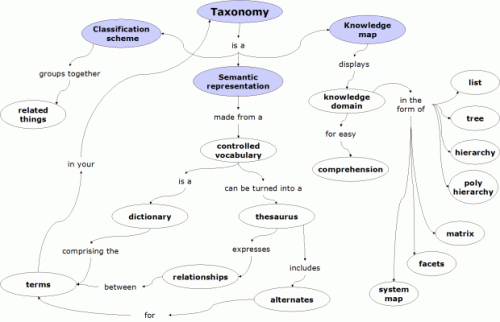
A taxonomic concept map on how to do taxonomies
Few things could suggest, better than these paired images, that the twin challenges of categorization and location for such a “repository of stuff” are dizzying. But if that conception is not the “right stuff,” neither is the whole-hearted focus on social interaction.
Competing Conceptions #2: The Gathering Place, the Agora, the Hub
It’s not enough to bring people together. Even and especially if you do manage to do that, you may only have a crowd.

Sunbathers at Manhattan Beach
Too much lollygagging? Maybe. Alternatively, I pictured it as part marketplace, part traffic jam.

Hyderabad Traffic and Market
The Commons is not (or not just) a place to come, hang out, interact. This is a more contemporary conception than a static repository, but it does have the enormous challenge of getting people to come and also structuring that activity without getting in the way of it. The watchword for such sites is often “If you build it, they won’t come” — and then what are you going to do?
Well, you could go organic. What these conceptions don’t take in is notions of growth, development, evolution — each a different way of framing the summum bonum of what we wanted the Commons to be and have.
Better Metaphor #1: Roots and Branches. Matt sent me this picture of a well-rooted tree as a possible image for the Commons:

Roots, roots everywhere
Lots of roots, but just one trunk — which reminded me that a stand of trees is often a clonal colony, that tree roots can beget new trunks in rhizome-like fashion. The great example is Pando [from the Latin for “I spread”] — aka the ”Trembling Giant” of Utah (a clonal colony of aspen trees with an interconnected root system that may be the world’s largest organism). I found a picture of those aspens on Wikipedia:

Quaking Aspens
These Quaking Aspens may quake and tremble, but we probably want a better suggestion of activity than that.
Better Metaphor #2: The Beehive.
Matt also sent me Jim Groom’s post “WPMu as Beehive,” which featured this image.

Honeycomb
That, strictly speaking, is not a beehive but a honeycomb — though what better visual way to drive home the point that you could have an organic image/metaphor that foregrounded storage? What I wanted was just such an image, but with some activity in it — some busy bees:

The idea of the beehive is especially useful because it helps to stress that, if you feel forced to choose between the repository and the hub of activity, you’re submitting to a false disjunction. As the beehive reminds us, you can have your storage and your activity too, your honey and your buzz. Social networks are about stuff as well as interaction. Facebook has become the largest collection of photos in the world, for instance. What might a Facebook for academics become?
Looking for a CMS (complexity management system)
June 8th, 2009
One good thing about not posting for a while: you’re subjected to so many things to react to that you start to wonder if, taken together, they might add up to something. There were lots of little things that made me think they do, but the big things were The 6th Annual Blended Learning Workshop in Chicago and WordCampEd in CUNY just a couple weeks ago. (For the latter, I’m linking to a recent blog post which is also an omnium gatherum of other posts and commentary on the event.) The former I’ve been in on (as a conference planner) since the beginning (almost since the turn of the century), but it was my first WordCampEd. And I might not have seen what they have in common if we didn’t have the Call for Proposals coming out for our own CUNY IT Conference (the 8th Annual). The test is to come up with a theme that is a big enough umbrella but still says something about where we are and/or where we are headed. For why this year’s theme felt like a no-brainer, I have to go back to CUNY’s problems with Blackboard.
As should be common knowledge by now (and this has certainly been dealt with elsewhere), many if not most of CUNY’s problems with Blackboard were not actually problems with Blackboard (but washed-out bridges to it). That, as far as I’m concerned, is part of the point. The really interesting thing is less the problem(s) than the inadequacy of any single-shot solution. In the wake of the Blackboard outages, a lot of the talk was focused on leaving Blackboard 8 for some other version of Blackboard (versions 6-9) or some other commercial course management system (Angel, Desire2Learn, etc.) or some open source CMS (Sakai, Moodle, etc.). And the problem with these ways of addressing the problem(s) wasn’t really that getting CUNY to switch would be as easy as getting an elephant to do backflips in a closet. It wasn’t even that, at least with commercial platforms, Blackboard (aka Blackborg) could go on assimilating the competition, as when it ate Angel recently. It was that switching CMSs meant trading Tweedledum for Tweedledee. There would be no real gain in functionality. (If you don’t believe me, go comparison shopping at EduTools.)
But that is moot. What the two conferences taught me was that it isn’t about platforms anymore. Well, it is — has to be — but the game has changed. It’s about managing myriad tools and choices now — the flavors of social media you can use with students, the various disciplinary dispensations and constraints, the divergences even and especially within disciplines according to pedagogical style, the powerful centrifugal forces introduced by the students (what they know, want to use, have been exposed to). Decisions about these happen at so many levels — institution, department, instructor, student — that there can be no one ring to rule them all.
If I’m looking for a CMS now, it’s no longer a course management system; it’s a complexity management system. There are a million plates spinning on poles that we have to keep jiggling. There’s the need to balance innovation with resource management, flexibility with planning, choice with some sense of a shared landscape, especially one where effective practices don’t just emerge but can be recognized. (We can only get so far with random acts of innovation.)
Like everything else I think about here lately, this takes me back to the (necessity of the) CUNY Academic Commons. If there is any way we are going to handle all that we must — keeping up, connecting up, sorting out what works (if only for some, or in certain contexts, or whatever other conditons you want to attach) — we have to do that collaboratively. There is no other way. To keep a million plates spinning, you need a lot of pole jigglers.


