


CUNYfying Uses of Technology
December 5th, 2016
[This is the keynote address given December 2nd at the 15th Annual CUNY IT Technology Conference. If you click on the image you’ll get the publicly posted Prezi presentation in a separate window. The headings and other text in blue type will indicate when to advance that presentation, if you want to use it.]
CUNYfying Uses of Technology
The title may call for some unpacking. The whole talk is about what I mean by CUNYfying, so we’ll see how I do; I hope it will come to seem more than an awkward pun. Since my bag is academic technology – technology used in the service of our core mission of teaching and learning – that’s the technology I’ll focus on for the most part. By growth, I mean not just increase in size but progress– moving forward as well as getting bigger. And by what’s in our DNA, I mean that our opportunities are what they are because we are a genuinely unique system, in situation, in mission, in prospects.
Who We Are & What We Have
I think any talk about CUNY should start with a map. (This is one in a series by Michael Dorsch of the Futures Initiative, about which I’ll be saying more later.) We can talk about how big we are (only Cal State & SUNY are larger), but the truly unique thing about us, what sets us apart as a university system, is how close we are. No other system comes close to our closeness.
The Shared Landscape
That closeness is not just geographical proximity. As Chancellor, Matthew Goldstein advanced the theme of the Integrated University, part vision, part realized promise. I want to look at some aspects of that – common systems and a Common Core as well as the Commons; a way to take in what is offered, even and especially if you’re a student: a level playing field in terms of bandwidth and access (fully in place this very academic year); a movement from locked down licenses and siloed services to shared apps and shared services.
Why This Is Important — In the Abstract
Harvard prof Jonathan Zittrain (in The Future of the Internet – And How to Stop It) came up with his 5 Aspects of Generativity as a way of navigating between two dystopian extremes: a corporatized, locked-down ‘net on the one hand, and one where malware and misrule have sway, a kind of wild west of the web. The middle way is one of general, mutual, palpable benefit – uses and practices that are also motivations for following them that are leverageable, adaptable, easy to master, accessible, and transferable. Instruction and communication in particular move from presentational to the collaborative, from the static and established to the flexible and evolving, from the top-down hierarchical to the shared and democratic, from siloed programs and practices to rich integration and collaboration. Motivations for adopting and adapting become self-driving and truly generative.
Examples of Incubated Innovation
Maybe that’s a little abstract. So let’s look at some examples, incubated projects that became project incubators – examples of what I mean by generative.
The Commons
First and foremost is the CUNY Academic Commons, launched in 2009 and directed by Matt Gold and a team of real wizards, notably lead developer Boone Gorges. They’ve created a platform for social activity that knits the work and the people of CUNY together. It is the single most successful academic social network based at any university. Now with almost 10 thousand members and over 750 groups, the Commons is, as its name suggests, an open marketplace of activity and ideas – an open source platform (actually a kind of mash-up of open source technologies) informed by an ethos of openness. Anyone can look at almost anything—and, if you’re CUNY, you can join in. Matt Gold has suggested that one of the most important principles of the Commons is serendipity – the chance discovery of that person or group that will take what you’re dong to the next level.
The CUNY Games Network
is an example of this. The answer to the question implicit in the headline of the edtech newsletter Edsurge “How Did Four Community College Professors Spawn the CUNY Games Network?” is “They used the CUNY Academic Commons”: a few faculty interested in educational games founded a group on the Commons. The CUNY Games Network could be searched for and joined. That may sound like no big deal until you realize how many different kinds of people and skills sets educational gaming take: you need people interested in design, in coding, in animation, in pedagogy, in so many things – and they’re likely to be scattered all over the place in terms of campuses and disciplines. Within a year or so of finding each other, the CUNY Games Network (now 169 members strong) was sponsoring conferences (which they insist on calling games festivals), securing platforms for the building and deployment of games, building advising teams to help those new to gamification. This is beyond anything mere proximity could make happen. And it is clearly, truly generative.
Commons In A Box
Talk about generative: the Commons began to breed. With the success of the Commons, the development team (presumably because they didn’t already have enough to do) created Commons In A Box, or the CBOX project, and preconfiguration of open source tech like WordPress and BuddyPress, replete with themes, plug-ins (many of them of CUNY’s own devising, like email notification of posts & activity). It has been downloaded about thousands and thousands of times. There are over 500 installations up and running. The CBOX showcase gives a sampling the institutions and organizations using CBOX. I was long an admirer of the SUNY Learning Network, so I love that the SUNY Learning Commons is a CBOX installation. The MLA Commons — built by the Modern Language Association, the largest academic professional organization in the world — is a CBOX installation. One of my favorite SF authors, Neal Stephenson, is involved in a project called Hieroglyph that brings scientists together with science fictionists to imagine hopeful futures. It runs on a CBOX. Amazingly cool. Amazingly generative.
Academic Works + The Commons
The Academic Works project is the Institutional Repository for CUNY, managed by the CUNY Office of Library Services and the CUNY librarians and called for by a resolution of the CUNY University Faculty Senate, created to preserve and disseminate faculty research such as articles and conference presentations; educational materials that can be shared with students and colleagues; student theses and dissertations; CUNY’s scholarly journals,; and so on.Academic Works makes these more discoverable, more secure, and above all freely accessible. There’s a map of the world at the bottom of the home page where you can watch the downloading of publications from all over the planet in real time – more than a quarter million this year. I have one article (co-authored with Matt Gold) downloaded over 800 times (because it’s co-authored with Matt Gold; still, very cool).
Now imagine that connected to your profile on the CUNY Academic Commons, which is just one aspect of what the OLS and the CAC teams have been doing with a planning grant from the Sloan Foundation. The plan is to join the IR’spreservationcapacity and searchability to the social activity of the Commons. They share an ethos of openness, but in other ways they quite different. Standalone IRs tend to be static; things can just sit on the digital shelves. Social networks tend to get focused on the moment at the expense of what’s gone before, the best of what’s been thought and said. We have a chance to combine the preservation and taxonomic organization of the IR with the intensive social interaction of the Commons – so individuals point others to resources, create study and discussion groups, and who-knows-what-else. This will be something quite new – and quite CUNY.
Something else that is quite CUNY – CUNY Advance
The coinage is Ann Kirschner’s – she’s the former Dean of Macaulay Honors College, now Special Advisor to the Chancellor — but the fairy dust (money) came from Allan Dobrin, until recently our Executive Vice Chancellor for Administration. He wanted us to do cool things with ed tech — things he would, within reason and fiscal constraints, provide the wherewithal for. So if the ethos of the CUNY Academic Commons is openness, that of CUNY Advance is support. It does not begin with ideas — I should stress this — but seeks them out, understanding that innovation is distributed while resourcing tends to be centralized. One way of doing that was the CUNY Innovation Survey that Lisa Brundage, Director of CUNY Advance, put together. It really is wonderful – every campus and (if feels like) every possible use of ed tech seems to be reflected, but we had to ask people to fill out a survey, so there is no doubt a lot more out there than we haven’t captured.
Science Forward
One beneficiary of CA support is an interdisciplinary approach to science semi-simultaneously piloted at Macaulay and Hostos called Science Forward. The point was to rise above introductions of specific disciplines to delineate scientific ways of thinking (the science senses). The cornerstone of the project, the part CUNY Advance supported, is the Science Forward Video Series: over a dozen high quality videos that are both rich and accessible, specific and interdisciplinary, featuring CUNY scientists – and open to anyone to use.
Science Sims
With the understanding that visualizations support learning, especially in certain learners, Science Sims is a project devoted to science simulations. The twist is that they are built by students. Here are just the Math sims from the full catalog of sims. The site notes that many simulations are old, and look like ‘90’s video games. “These sims are fresh – built by students using modern javascript libraries. Sure, one day, they too will be old–but that day is not today!”
Flipped Gen Chem
The oldest, biggest, and greatest of the CUNY Advance projects just two weeks ago won, at the Online Learning Consortium Conference, the OLC Digital Learning Innovation Award. These are the slides showing the results that (I think) clinched the award. They’re the results of an approach where all the instructional content is delivered online, then students meet once a week to do problems, ask questions, compare notes. The results are for repeated offerings of courses across multiple campuses using the same tests and often the same professors. So the comparison is not just between the Traditional (TR) and Flipped (FL) approach but between strikingly different demographics that lead to a 40% difference in the student success rates. And see what the Flipped approach does? (Note the blue rectangles.) It effectively erases that difference. It doesn’t just bump up success 15% over traditional even where students are stronger. It takes the students who couldn’t succeed and shows them how to. And it does this when the students and tests are the same, with huge Ns and over repeated terms.
The project, led by Pam Mills and Donna McGregor (formerly of Hunter, now of Lehman), began with an epiphany. Teaching in sections of 1000 students or more, they realized they could do this better online – that it was already a kind of distance ed. But realizing that was just the beginning. They threw out the textbook, and they designed the course from scratch on pedagogical principles of scaffolding, self-pacing, constant assessment. The Commons team built a platform to their specifications – this was a case where technology was not a box we fit the course into, but a reimagined pedagogy that defined the box. That’s one reason I should stress that the full title of the OLC DLIA (already long enough) is the Faculty-Led DLIA. Pam and Donna believe they hit on principles that apply to all STEM instruction. If you are involved in that, I would talk to them. Make this even more generative.
Online Courses and Global Search
We can’t all be Pam and Donna, reinventing courses and pedagogy from scratch and defining customized platforms, but a lot of us can benefit from innovations (and, yes, shared landscapes) that were seeded long ago and might, just might, be coming to fruition now. I got the title of Director of Instructional Technology back in 2001 because we needed PI for a generous grant from the Sloan Foundation. We promised a couple hundred online and hybrid courses and not just hit but nearly almost trebled those targets. We got another 4-year grant and did more. And we evaluated the heck out of those courses. Students reported that interaction with their instructors was twice as high as in traditional courses, that interaction with their peers, 3 to 5 times as high. They thought they learned more, they thought they worked harder, and they wanted to do it again. (The instructors said the same thing, which clinched it for me.)
A sidebar: That Director of Instructional Technology title changed to University Director of Academic Technology in 2008 (why? Slight pay raise, plus and acknowledgment that that Academic Tech takes in things – digital scholarship, IRs, etc. – that aren’t strictly instructional). Either title guarantees one thing: you get bombarded by vendors. So I have a boilerplate response. It begins “You are confusing me with someone with staff and a budget.”
But CUNY gets a two-fer from me. In 2008, I became CAO of a school—the CUNY School of Professional Studies– that now has more than a dozen online degrees, with more on the way. Because it’s amazing what you can do with staff and a budget. That’s just at SPS. (I have to give a shout out to the school that’s our host: John Jay has a bustling, burgeoning online program, with its own online degrees and programs—and more on the way.) Back to SPS. Because 8 of its online degrees are bachelor’s degrees– by the way, ranked by US News & World Report in the top 5% of all online bachelor’s in the country (and #1 in NYS)—we had to build an online General Education curriculum. Something interesting happened afterwards: University-wide Gen Ed reform, with at least the prospect that all courses are generally transferable.
Remember: transferability is that one of the five aspects of generativity. Let’s think how that might work, not abstractly, but practically. First, there’s a ready-made online Gen Ed curriculum, so any school can now build a fully online undergrad degree with just the courses in the major – do 15 or so online courses, and you have an online degree. Second – but likely more important with Gen Ed accounting for more than a quarter of all undergrad course work, online Gen Ed means a lot of courses students could take to advance their academic progress, a lot (here’s the key) that might fill out fuller schedules if some of the courses could be taken online, guaranteed to fit any schedule as long as students take the time to do the work. Right now, a third of our undergraduates are part time – how much could we move them to full-time and get them across the finish line faster with the option of online courses?
Of course they’d have to be able to find them. Enter Global Search, a tool built by a crack CIS team led by Zev Jeremais and Youngren Ponnuraj and just launched in July. It allows any student to search by across institutions by course title, type, general ed category, mode of delivery, and so on.
What This Can Mean
Basically, we have an accelerator. What it accelerates is first and foremost degree completion. This in itself builds enrollments on the established and hardly counter-intuitive principle (the term in the research is academic momentum) that students who earn credits and satisfy degree requirements more quickly not only move faster through the curriculum but are retained at a much higher rate(because less likely to fall by the wayside). So this “accelerator” can retain and accommodate more students, while making things easier for faculty as well as students in a University where everyone commutes. It can extend outreach and capacity without building new buildings even as it raises reputations and profiles. Think about an online MBA at Baruch might mean, for instance, or an online Cybersecurity degree at John Jay. (I know they’re thinking about it.) Think about what extended reach combined with relatively low tuition can mean for CUNY schools generally.
CUNYfying, then, means…
First of all, further realizing and enhancing the core mission of CUNY, of access and/with excellence. I am a little distrustful of that latter term. Like Quality in Zen and the Art of Motorcycle Maintenance, it’s difficult to define. But I think we can all get behind a near-synonym we can actually point to and measure: student success — getting students through, getting them degrees, readying and not just credentialing them for the world as it is now. I think we are poised to do that better than ever.
Realizing the virtues of closeness (synergy is another word I don’t quite trust) means understanding closeness is not identity. Unlike Penn State, which also has 24 campuses but the slogan “One University geographically distributed,” we don’t all represent different points of access for the same curriculum. We are a federation of campuses with different constituencies and different purposes but lots of overlaps. That’s a good thing because I believe less in redundancies than richness and reinforcement, less in conflicts than complementarity. But what’s really good about closeness not being identity is what closeness then leads to:
- Innovation, bred by difference, comes from the edges not the center (the more fringe the better); it bubbles up rather than trickles down
- Incubation. If you want more than random acts of innovation, you need to incubate (support) –incubate, not impose University-wide adoption, but to nurture to maturity
- Dissemination is the next step—etymologically that is spreading the seed, and, by extension, letting it take root and give fruit in different ways at different places
- Collaboration is the key – collecting and conferring on effective practices that vary by context and constituency – and making those visible (closeness is sharing) –
Because I’m feeling that I’m getting abstract again, let me show you an example of what collaboration can look like, and how much difference it can comprise. Cathy Davidson (keynoting this conference 2 years ago) started the Futures Initiative here at CUNY and one of its first fruits was a course on Mapping the Futures of Higher Education that was actually a network of courses – applications of new pedagogies and technologies and shared practices and compared notes across more than a dozen courses, disciplines, and campuses – where else but in CUNY?
The thought to leave you with:
The goal is not to catch up but to leapfrog*
*Not to get to where everyone else is (or is trying to get to) are but to go beyond them in our own way
not parity, but integrity*
*not to be on the same page with everyone else but to write our own story
To our own selves be true.
Both/And — or When You Come to a Fork in the Road, Take It
March 18th, 2015
This is a version of the keynote talk I gave at City Tech’s Tech Day (3/18/15).
Preamble (Don’t start the Prezi, linked to the image, just yet). I want to give just a little personal context, since it’s always good for people to know why you’re saying what you’re saying. Because I’m on LinkedIn, I had this weird experience as we hit 2015 – people wrote to congratulate me on the 15 years I’ve been overseeing Academic/Instructional Tech. That’s an insanely long time to be in a job like that, when you think of all that’s changed. But time does tell. (As Emerson said, the years teach much that the days never know.) Looking at reviews of recent publications — The End of College, for instance – I had this sense of déjà vu and went and pulled down The Social Life of Information (2000). Taking on the misguided prophecies of the nineties, it starts by saying that “the rise of the information age has brought about a good deal of ‘endism’” (16). So I want to say a little (more) to counter all the hype and hysteria about what technology will do to higher education as we know it, partly because we’ve been through this before.
OK. If you click on the image, you can follow along, advancing the presentation every time you see an underlined heading.
Revolutions/Game Changers – It seems lots of people talking about technology want to say that one thing or another is going result in a revolution or be a game changer. Such claims are so common we may fail to realize how rarely they’re true, Or maybe, which is at least as likely, we sense the terms themselves are abused and overused. Revolutions are dramatic changes — changes so dramatic they beg comparison to the violent overthrow of rulers by those they rule. Games, being highly rule-bound and regulated, change rarely because they necessarily change by a rewriting of the rules. Neither “revolution” nor “game-changer” seems to describe the changes that are essentially, at least according to Clayton Christensen, disruptions by outside forces or events or (especially) technologies. We are likely to get further with relevant examples and precedents than such fuzzy terms.
The Last Great Disruption – The past gives us a great point of comparison in the invention of the printing press and what ensued. It was both more and less radically transformative than it figures in the popular mind. We tend to forget that the ability to print books may actually be more easily and quickly effected than the widespread ability to read them — something, frankly, we are still working on. People at the advent of such changes are even less affected in seeing how they’ll play out. This is especially true of those who feel threatened by such change. They picture the consequences for themselves that may or may not come to pass.
The professors of the day were a case in point. They did feel threatened. They had access to texts, much fewer in number before than after the printing press intervened, and they imagined they would be less important or necessary because they saw their role largely as saying to their students what they texts said to them. As it turned out, saying what they books said was not the heart of teaching, or at least what teaching would become. That, instead, would lie in interpretations, applications, and extensions of understandings that would evolve over time, and widely accessible books, far from replacing teachers, would instead give them a starting point to do much more than say what was said.
Again, this took a long time. The real effect of the printing press on higher ed and the world at large required a vast growth in literacy and all the social and cultural and economic changes that would bring.
Not So Fast — So such changes are complicated, and one of the complications is surely that we can pretty much count on change being resisted. Opposing change has a long history, so much so that many posit it as an aspect of human nature. When Socrates spoke against writing in Plato’s Phaedrus (casting it as the enemy of memory), he was repeating arguments borrowed from the Egyptians, as far back in time to him as he is to us. This is not to say that Socrates was entirely wrong. In fact, he is the progenitor of the many moderns, people like Nicholas Carr and Sven Birkerts, who say that the Internet is the enemy of everything from sustained attention to careful thought. (By the way, if you want to read about faculty resistance to online education, I’ve blogged quite a bit about that, especially here.)
Sidesteps to Progress — It’s not just that technological innovations take time to overcome resistance and reach their potential. They are often not used as they were expected (even intended) to be used. The history of technology is a series of such stories. One example is how the epochal change in communication that telegraph amounted to and how all (from our perspective) equally epochal changes that followed — the radio, the telephone, the phonograph — were conceived of in terms of the initial guise of extensions of an invention they diverged radically from (and in some cases supplanted in the process).
Example of SMS – Again it’s not just the technology, but the use-niches it falls into and flows out of. To get a sense of all that is behind the reasons for texting, check out danah boyd’s It’s Complicated: the Social Lives of Networked Teens.
Both/And, not Either/Or – So we accommodate the new, arrange it on our landscape of options till the landscape itself is changed, and the (smart)phone leads to the erasure of the public phone. The point is that things do change, and dramatically, and faster than ever before because change has accelerated to the point that what has changed is change itself, becoming the expectation and the rule, not the disruption of that. I just mentioned the iPhone. It’s been with us less than a decade; we already can’t imagine life without being constantly accompanied by this thing that is our newsstand, entertainment center, library, game collection, camera — and, oh yes, phone. It’s not just public phone booths that have disappeared. What has happened to video stores, encyclopedias, half of our newspapers? If we take the long view in higher ed, how do we make the right bets?
Mr Rogers can help, ER and his Diffusion of Innovation, running through five editions and giving us the term “early adopter”, particularly his 5 attributes of innovations, and how they bear on our work – relative advantage (almost never cost initially, but the ability to do something better, is hard for educators to see, validate, and inculcate — because we don’t teach people how to teach in higher ed), compatibility (out-of-the-box doesn’t fit in our box), complexity (enough said), observability and trialability (a problem, teaching being oddly closeted).
MOOCs amount to the exception that proved the rule — very observable and trialable (but that was part of the problem). The Massive Open Online Course was supposed to be the killer app for higher ed, our revolution and tsunami, but was a failure even (especially?) when free because at its heart it was the opposite of something new: a shopworn pedagogy, and an egregious scaling up of the large lecture class. Attempts to make it work turned out to be less massive, or open, or online, or even course-like – now absorbed into the landscape as a fringe element, useful for certain kinds of blending (the flipped MOOC), executive ed, and life-long learning. Note how, being old at heart, it was swallowed up by the already-there. Apparently we had to learn again what the printing press should have taught us half a millenium ago: transmission is not education.
So what will work? We need something that is essentially an update of Rogers, something that gives us a way to judge the value of technology in what educators value. Which brings us to
Zittrain’s 5 Aspects of Generativity – from his 2008 book The Future of the Internet—And How to Stop It. Generativity is Zittrain’s middle way between the twin dystopias of disruptive chaos on the one hand and corporatization or “appliancizing” (his word) on the other. The 5 aspects of generativity have a striking homology with Rogers’ 5 attributes of innovation: Leverage (cf. relative advantage – reach that is not so much scaling up as networking out, and moving from appointed time to point of need); Adaptibility (cf. compatibility – free from lockdown and compartmentalization); Ease of Mastery (cf. complexity — especially freedom from being led by the nose and told RTFM); Accessibility (cf. observability – free from the hierarchy of the top-down, getting in on the ground floor); Transferability (cf. triability – you cannot only try it out but make it your own, not just adopt it but adapt it). Want to see all this in action? Check out
The OpenLab : The best example of generativity I can think of. It’s a vast and vastly successful example of information made into knowledge and knowledge made visible. That was the whole point of The Social Life of Information: for information truly to inform (and not be inert data), for it to be transmuted into knowledge, it has to be socialized, applied through sharing and collaboration, built up mentoring and community building. That’s exactly what the City Tech’s OpenLab is and does, and it’s glorious.
One last slide: My contact info, in case you want to get back to me on any of this.
Online Education in CUNY
December 7th, 2014
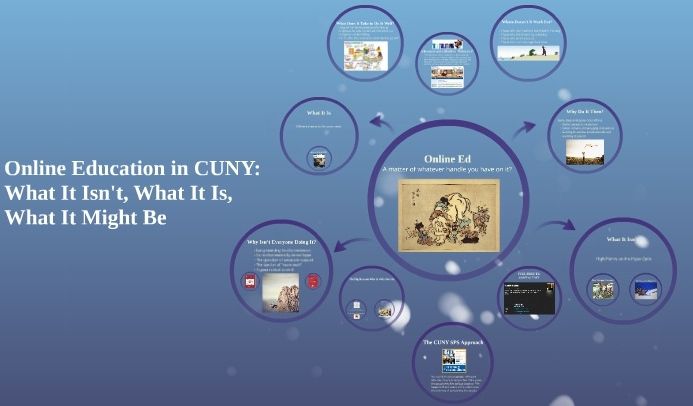
[This particular presentation — the title seems hubristic, but was assigned — was given at the University Faculty Senate Fall Conference on Online Learning on 11/21/14. Clicking on the image above will give you access to the slides. A kind of outline/summary of the talk is below. The upper-case headings are also slide titles — so, should you want to see the slides while reading the text, those headings will signal when to go to a new slide. There’s a 2-part video of the talk available here and then here.]
ONLINE ED: a matter of whatever handle you have on it?
- Like the parable of the blind monks and the elephant, online ed “is” whatever aspect of it people think they have a grasp on at the time. What comes to mind first? The proprietaries? The overhyped MOOCs? Or more conventional on-going endeavors?
- It’s worth noting that OE isn’t any longer new or especially localized. It’s available now at almost all public institutions of higher ed.
- The single greatest shift is away from the old image of satellite operations and mutant offshoots to integrated approaches that serve as many or more local students as “distant” ones; 80% of the students are typically within a short driving distance and/or the area code of OE’s point of origin.
WHAT IT ISN’T: High Points on the Hype Cycle
- Huge Untapped Potential – You’ve seen the headlines: “Campus Tsunami” / “Revolution Hits the Universities” – the idea that harnessing the power of online ed will change the educational landscape. It hasn’t.
- The Thing to Fix Higher Ed – The idea that online ed will take care of all the problems afflicting IHEs: rising costs, soaring student debt, and unresponsiveness to accelerating changes in the technological and economic realms. Again, it hasn’t (and could only if reality could be bent as the laws of physics are in cartoons).
WHAT IT IS: Different means to the same ends
- Defined in terms of learning outcomes, outline learning has achieved real success: a study of studies (a meta-analysis of 57 different comparability studies that satisfied strict definitions for research design) found that online learning did a bit better and blended learning did a lot better than face-to-face instruction.
WHY ISN’T EVERYONE DOING IT?
- There is in fact significant resistance to online learning from the faculty – well documented by recent surveys (Conflicted, the recent Gallup poll); the needle hasn’t moved in a decade (and the hype hasn’t helped)
- The issue of more work … really isn’t an issue – faculty work hard as it is – but something too few recognize is the challenge for first-timers (learning to ride a bike is very different from getting back on a bike), and this is where the need for support comes in.
- The question of whether there’s adequate support, the tech is good etc.
- Above all, getting people to change means giving them good reasons to: why move from tried and true methods
WHY DO IT THEN?
- The early days of CUNY Online – focusing on so-called “course conversions” – explicitly sought to accomplish the same goals online, and the main motivation was access to web resources and discussions, and for the blended courses, freeing up classroom time by what we now call “flipping” – putting instructional content online so that class time can be focused on point-of-need instruction, cultivating critical thinking and problem solving – the things that we’re most interested in.
- The single most significant difference online represents: interaction (with content, among students) that would chew up too much class time is easy, engaging, beneficial
- Online instruction also is enormously helpful to students who work, notably our many students who are in-service professionals
THE CUNY SPS APPROACH
- For SPS specifically, the issue was, in a work, access: it was serving the stop-outs (more than 10K a year) – the people who left college because “life happened” and would need online as the only way of completing the degree
- Interestingly, there are currently 31 million adults in this country who have some college but no degree, and nearly a million in NYC alone; this is the target population for SPS
A RESOURCE AND A MODEL TO “FINISH IN 4”
- Another reason we really haven’t availed ourselves of much: the new push for students to “finish in four”; think how much easier it would be for students to do that if 1 or 2 of those up to 5 classes could be online or hybrid
- And think of the growth in enrollment capacity if people take that seriously – how, gradually, we could move to significant access to gen ed courses, bottleneck courses, etc.)
WHAT DOES IT TAKE TO DO IT WELL?
- Support for the students and the faculty: orientations to the software in use
- Emphasis on experiential and interactive use
- A Coalition of the Willing: people should do it because they want to (disciplinary, even individual reasons)
- For faculty specifically, time to prepare and ongoing support
WHOM DOESN’T IT WORK FOR?
- Those who don’t want to teach/learn this way
- Those who think learning is lurking
- Those who rely on spontaneity and seat-of-the-pants adjustments
- Those who have time management issues
THE BIG REASONS WHY & WHY NOT (TO)
Why: expanding connections (among learners, to content, to the world) and making (models of) teaching and learning so much more visible (for other faculty, students)
Why not: making/saving money (this is not cheaper); making/taking it easier (this is more demanding/engaging)
[THE LAST SLIDE (my profile on the CUNY Academic Commons)]
Please feel free to contact me with comments and questions.
The Problem(s) with Innovation
May 12th, 2014
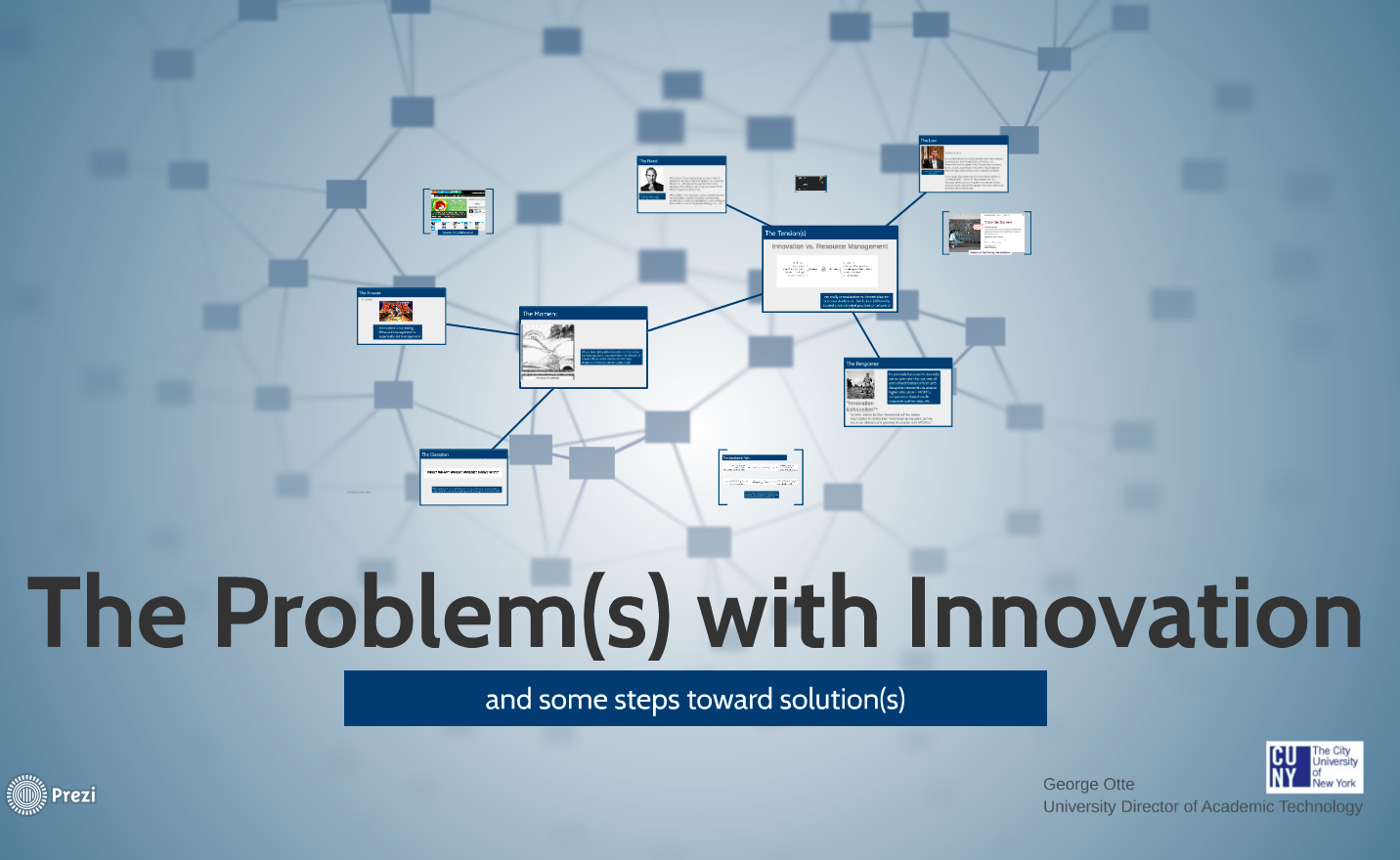 [This is my keynote at the Bronx EdTech Showcase on 5/9/14 — (reconstructed) text of the talk here,with access to the slides by clicking on the image. The upper-case headings are also slide titles — so, should you want to see the slides while reading the text, those headings will signal when to go to a new slide.]
THE PROBLEM(S) OF INNOVATION
I feel I need to justify the title a bit. I’m coming to you with problems? What’s that about? First of all, since all you folks are innovators, let me say that you are not the problem(s). On the contrary.
But if I ask how many of you feel as noticed and supported and impactful as you’d like to be, you’re probably aware of something we might call the problematics of innovation. More on that directly.
Second, this is not just an exercise in problem definition. I do want to get on to some steps toward solution(s). But it is better to define a problem before trying to moving on to a solution
So the Problem(s) with Innovation can be traced to a larger institutional problem — the reasons innovation doesn’t take hold are also the reasons institutions are notoriously slow to change.
I won’t deny for a moment that we are talking about complicated dynamics (or lack thereof) , but I’m a great believer in simplifying (if not oversimplifying).
THE TENSIONS
So one way of looking at the problem(s) is to realize that we are dealing with a set of tensions — specifically, tensions between how innovation percolates up and how resources filter down.
Basically, we are talking about tensions between innovation being centrifugal and resource management being centripetal.
Innovation happens at the edges, is dispersed, scattered, disruptive because it happens outside of the established status quo.
Resource management is top-down: organized hierarchically, in clear chains of responsibility and control, subject to audits and so highly documented and monitored. (Anyone tried to get a purchase requisition through lately?)
Admittedly, there’s nothing especially revelatory about seeing that ideas and money don’t flow the same way.
What’s worse, looking at it this way can induce apathy and even despair.
If we are going to think of what, if anything, we are going to do about this situation, we need to get to the bottom of these tensions.
THE QUESTION
WHO? WHAT? WHEN? WHERE? HOW? WHY?
The famous journalistic questions are supposed to help us analyze situations, but here I think they’ll just get us lost in the weeds. It’s time for simplification again. The key question is WHY? If these are differently motivated (as well as differently located) behaviors, what motivates them?
THE ANSWER
In a word, RISK.
- Innovation is all about taking risk. It’s being experimental, trying things out, testing hypotheses, being able to fail, revise, re-try.
- Effective resource management is risk avoidance. Resource management is essentially risk management.
The question is what happens when risk avoidance becomes risky.
THE MOMENT
It’s worth dwelling on the picture on this slide for a moment; it’s about Education, a bridge over Ignorance, and “Safety First” leads to the Road to Happiness.
Playing it safe might have been the Road to Happiness in 1914, but not in 2014.
The argument could be made that we have reached a game-changing moment when the most dangerous thing you can do is play it safe.
THE NEED
There’s an interesting analogy with not just what Steve Jobs said but what he was facing when, confronted with what seemed like insurmountable problems, he said ““The way we’re going to survive is to innovate our way out of this.” This was after he’d been kicked out of then brought back into Apple, post-bubble (and mid-recession, if not the Great Recession), with a sense that the excitement had gone out of technology while the pricy-ness and corporatization had escalated. In that crucible, we got Mac OS, the iPod and iTunes, the iPhone and iPad, IOS, and so on.
Jobs was not himself an innovator, of course, but he was a supremely effective driver, supporter, and vetter of innovations, roles that will be relevant to what I getting to.
In the meantime, think about where we are in higher ed: Funding from all levels is receding. A degree has never been important, but resources are ever leaner. Technology promises solutions but also higher costs and complications. Calls for reform abound as the challenges, especially stories of crushing student debt, raise concerns that institutions of higher education are unresponsive, inefficient, unable to change. Whatever else higher ed does, it can’t do nothing.
THE RESPONSE
That, of course, is part of the problem. Higher ed can be seen to be doing all sorts of things, but they are beginning to look like exercises in throwing stuff at the wall to see what sticks.
Dan Greenstein coined the term “Innovation Exhaustion” to describe the point this has brought us to, specifically with respect to MOOCs, which went through a huge hype cycle – talk of “campus tsunamis” and “revolutions” gave way to disappointing results and shrinking expectations. I don’t want to get off on a MOOC tangent, but the really significant thing about that explosion of hype and activity was that MOOCs, by definition, don’t need the mobilization of faculty: they are the printing press revolution of our time, a dramatic scaling of reach and access to content – like the lectures of a single professor (just as the printing press could widely disseminate the views of a single author). MOOCs function on the star system; you just need a celebrity prof and a platform or provider. In short, you can circumvent the system. Resource management can just fund some “hot” someone or something, doesn’t need to innovate or even foster innovation.
THE LAW
This is against the Law – or at least “Carlson’s Law” (Curtis Carlson being the head of SRI Int’l – one of those acronyms that doesn’t stand for anything, though it used to stand for Stanford Research Institute). This is what Carlson says about how innovation works — these days, at least:
In a world where so many people now have access to education and cheap tools of innovation, innovation that happens from the bottom up tends to be chaotic but smart. Innovation that happens from the top down tends to be orderly but dumb.
As a result the sweet spot for innovation today is “moving down,” closer to the people, not up, because all the people together are smarter than anyone alone and all the people now have the tools to invent and collaborate.
This is pretty interesting (and verifiable) when you think about it. Access not just to knowledge but to tools (not least of all the tools for tapping into “the wisdom of crowds”) ought to foster innovation, at least as long as we don’t have things getting in the way. The critical thing is figuring how far we should be “moving down.” (Quite a ways, perhaps, but how far is too far?)
THE (GOLDILOCKS) POINT – what’s not too high up, nor too low down
That’s not just a place – remember that we’re talking about not just the location but the motivation of behaviors.
So, let’s think about what we want from Innovation and Resource Management. [Two more mind maps.]
In both cases, we are thinking about two things – rights and benefits. (You could also call them expectations / goals & outcomes, especially if you’re doing Middle States work.)
Bottom line: Innovation needs Freedom and Flexibility; Resource Management (RM) needs Accountability and Evidence.
Above all, they need each other: Innovation is like a plant that needs watering; RM is like a watering can that has no reason for existing if it doesn’t support growth. They meet at Visibility: Innovation needs to get noticed; RM needs to notice what to support (if that watering can is not just going to soak the entire landscape — and remember that water here is a metaphor for money).
Steps in this direction
Let’s take ANOTHER LOOK AT CARLSON’S LAW, specifically what he says about the “sweet spot.”
Innovators have to notice each other, work together, realize that a rising tide lifts all their boats. They may be distributed out there at the fringes, but they need to find a way to find each other, work together, collaborate. So what are the ways?
THE CUNY ACADEMIC COMMONS
The CUNY Academic Commons is a great example of providing the means and the tools to invent and collaborate. It was itself built by collaboration. Memorably (I still get teased about it), I had told the team, “If you build it, they will fund” – and they did. By the time we got funding, a team had put together a beta version that had literally hundreds of people in it, banging away at it. I’m not sure that’s the model, but it is a model.
You’ll be hearing later, in the lightning panel, from members of one of the largest and most active groups on the Commons, the CUNY Games Network. If you think for a moment about the many skills sets entailed in educational gaming – you need design specialists, pedagogy people, programmers, and, yes, gamers – you realize that you have to tap into many fields and folks to get what you need. You pretty much have to work collaboratively. They do. The conference — the CUNY Games Festival — they put on in January was amazing.
Speaking of conferences, think how much collaboration this one represents, and how much use it made of the Commons platform.
I could go on, but I need to go on.
THE CUNY INNOVATION SURVEY — http://bit.ly/PUDqbB
This survey is the brainchild of another group on the Commons, the Innovative and Disruptive Technologies group. Realizing that supporting innovation, especially disruptive innovation, is probably not going to be a matter of telling the powers that be, “Give us money and we’ll do cool things,” the IDT group has accepted the challenge of documenting innovation that’s already out there and at work in CUNY, the better to build on that.
The trick is that this also requires collaboration. Enter the CUNY Innovation Survey. The approach taken is through self-reporting. We’ve reached a point in the survey responses where we have representation from all the campuses, and you can browse through the projects that way, but you can also view by category, type, and time of submission.
The point is giving the requisite visibility to what is going on — avoiding reinventing the wheel, failing to find synergies, but also learning from diversity (e.g., different approaches to eportfolio), and there are many things we can learn from each other.
In fact, one of our greatest resources in CUNY is each other. We are a multi-campus system that can and should learn from multiplicity, should share and diversify but also consolidate and reinforce effective practices and innovations.
Logical next steps (not yet taken because they have to be endorsed above my pay grade, and at this exquisitely transitional moment for CUNY, but there are encouraging signs that they may be):
- Structures for funding local innovations, start-ups, and plans. (I’m not speaking of external grants, which contribute to the ephemerality of innovations — the money stops flowing and the innovative practice dies or goes dormant; instead, I’m speaking of opportunities for CUNY to invest in its innovators — and invest further if successful innovation seems worth scaling up.)
- Structures for developing springboards for collaboration: participatory MOOCs and workshops and roundtables or seminars that ready faculty to learn more, get to the next level.
- Opportunities for mentoring – both to do it and to have it done unto you, and in environments where everyone has the time to do this.
I’ll leave you with means of contacting me, and how better than through MY CUNY PROFILE, a major feature of a major upgrade of the Commons. What you’re seeing is just the top: you can also find my bio there, my publications, my interests, my positions (more than you want to know, really). It’s something everyone should use, particularly for a point of connection I’ll draw your attention to – the CUNY.IS/your-name-here URL shortener. This is not an act of hubris but an acknowledgement that, like the hundreds who use the same kind of CUNY.IS/_____ quick link (may there soon be thousands) we are all CUNY: together, collaboratively, we are what CUNY is.
That’s one the thought I’d like to leave you with, that and
Innovation is not tech; Innovation is people.
The solution is not a hierarchy; the solution is a network.
MOOCs: Flame out or Flame on?
March 28th, 2014
 Be careful what you wish for. Started back in 2009, this blog on academic technologies was hijacked in 2012 (“the Year of the MOOC“) by MOOCs. I felt so compelled to blog about these hyper-hyped (then much transmogrified) Massive Open Online Courses (getting less massive, less open, less fully online, and less course-like all the time) that, after one or two retrospectives, I’m sort of at a loss when it comes to what to blog about these days, now that the once mighty MOOC zeppelin seems a deflated blimp. Not that I couldn’t find plenty to say about ed tech and online learning and so on BM (Before MOOCs). So I’ve decided to do a combination update/valedictory and move on. At least for the nonce.
There are two forks to the waning stream of stories on MOOCs. One still rings positive. The other, the dominant, is that they’re so over. Far from being the tsunamis or revolutions that would wash away or remake higher ed as we know it, they’re at best a part of the “incremental change” that higher ed is seeing from technological and putatively disruptive incursions, or so says “The Sky Isn’t Falling,” a report on SXSWedu, “which featured cautious and intentional ways of trying out emerging technologies” and came to the general conclusion that “ed tech will continue to be used as a complement to traditional higher education.”
And this is what the advocates are saying. Meanwhile, some highly placed people are raining on the parade already past. Hillary Clinton, speaking at the Globalization of Higher Education conference earlier this week in Dallas, did not criticize MOOCs and online learning specifically, but she did (as cited in Inside Higher Ed) say there’s “no substitute for the kind of learning that takes place in a well-taught classroom,” and that “technology is a tool, not a teacher.” And former fellow Cabinet member, now UC President Janet Napolitano, “joins skeptics over online courses” (as Monday’s Reuter headline had it), specifically those big productions that are supposed to handle more students at a lower cost: “There’s a developing consensus that online learning is a tool for the toolbox, but it’s harder than it looks and if you do it right, it doesn’t save all that much money,” she said about the prospect of cheap online courses that might let California educate more students for less money.
From 30,000 feet, it may be hard to tell the kind of online courses we have been doing for the past two decades from the MOOCs of the past two years, but academic administrators, a little closer to the ground, have no such trouble. In the 11th annual report tracking online education in the US, it turns out that, in the space of just the past year, the number of academic leaders who thought MOOCs were sustainable online offerings dropped 5% (from 28% to 23%), and the number who had concerns about credits or credentials from MOOCs went up almost 10% (from 55% to 64%). (By contrast, the number reporting that online education generally — not just MOOCs — was not critical to their institutions’ long term strategy dropped to an all-time low, below 10%.)
So are MOOCs just a blip? Given not just the attention but the investment afforded MOOCs, you would expect some resilience to them. But where will they flow, like water blocked in one channel but not another? Some sense of an answer may be in the very critiques and declarations of failure. The low completion rates are notorious, even in the popular press, and not least of all in the Times, which fed so much of the original hoopla with pundits like Brooks and Friedman and big spreads like the one on “the Year of the MOOC“; but in another sense the limits of their wide reach was a sign that being big didn’t mean reaching (and especially working for) everyone. As the potential retracted, it essentially redefined the logical market: the successful students for MOOCs were those who were already college educated, and this was especially true of MOOCs that had that touted global reach.
Enter the latest news: Coursera has hired Richard C. Levine as its new CEO, and edX has Wendy Cebula as its new president and COO. Levine was the president of Yale, while Cebula was a Vistaprint executive (and it’s interesting that the open source provider should be the one to go with the corporate figure). But what they have in common, besides the intriguing synchronicity of these announcements, is expertise in reaching beyond standard market definitions. Levine is an acknowledged leader in the internationalization of higher ed; Cebula is an expert in “global growth.” You can expect both of the remaining big three MOOC providers (now that Udacity has left higher ed for corporate e-learning) to go after the market for higher ed abroad that fits their strengths: the hungry but not the starving, the eager-to-be-elite. (There’s more to the reconfiguration of the major MOOC providers than these recent appointments signals, but I noted as much in an earlier post.)
So MOOCs will fill the interstices, and not the ones that most need filling. But we shouldn’t confuse the evolving business model with the lessons MOOCs have taught: that teaching (and its reach) can scale dramatically, that new modes and media make for new possibilities, that what might not succeed as a standalone may work well and complement or supplement. Cathy Davidson’s recent MOOC (to a considerable extent a MOOC on MOOCs) pulled out all the stops to show what a rich trove of possibilities that is, with layered readings, guest lectures, local as well as online discussion groups, multiple tiers of participation and evaluation. Even in this form (or array of forms), and pace Clinton and Napolitano, online learning is not just a (singular) technology or just a (singular) tool but a huge bag of tricks we’ve only begun to learn how to play with.
Feeling Disrupted?
January 30th, 2014
 A colleague has a great line: when the world ends, he wants to be in the groves of academe. “That’s where everything happens last.” And he has a point. Working on analogies from business, experts like Clayton Christensen, the guru of “disruptive innovation,” tell us academics to brace for accelerating change, even tectonic shifts, but the only tremors seem to be in the press — and sometimes they seem to be delirium tremens. We’re told to expect tsunamis and revolutions, but we look around, not just a day or two but a year or two later, and almost nothing has changed. Make that more like one step forward, two steps back. The New York Times declared 2012 “The Year of the MOOC.” I called my retrospective on 2013 “The Year of Un-MOOC-ing.”
None of this is news. In fact, if you’ve been following the press, not least of all the popular press, you’ve seen the chastening headlines for some time, like this one from Time magazine in September: “All Hail MOOCs! Just Don’t Ask if They Actually Work.” In addition to those published since my December retrospective, we have obits, including one called “MOOCs: Been There, Done That” that ushers the disruptive phenom of Massive Open Online Courses into the boneyard where ventures like UNext, AllLearn, NYUOnline, and Fathom are buried. Another, from an economist at Stanford, explains why the colleges that gave rise to the major MOOC providers like Coursera, Udacity, and edX should never accept credit for their MOOCs. Perhaps most tellingly, a recent report on a consortium of universities agreeing to give credit for MOOCs revealed no cases of students asking for such credit: “Once again, an invitation to redeem MOOC learning for traditional credit had been met with the sound of crickets.”
It’s interesting to look at Jeff Selingo’s latest take on the MOOC phenomenon, which first recalls the good old days of MOOCs, the “frenzy prompted The New York Times to declare 2012 ‘the year of the MOOC.'”
Then, last year, all the curiosity and hype that surrounded the 2012 version of MOOCs turned to condemnation and remorse. High-profile campus experiments using the courses proved disappointing. Faculty members at traditional universities fought off efforts to allow the courses to replace face-to-face teaching. As 2013 came to a close, another proclamation about MOOCs arrived in this front-page Times headline: “After Setbacks, Online Courses Are Rethought.”
What makes Selingo’s take interesting is that he was, with Brooks and Friedman, one of the “adapt or die” prophets, a journalist fueling the hype. But he got a book out of it (College (Un)Bound: The Future Of Higher Education And What It Means For Students), and now he is, as his byline notes, “a professor of practice at Arizona State University.” An academic. And you can tell by the way he describes the write-off of MOOCs he’s getting ready to write-off that write-off. After citing that Times article (“After Setbacks, Online Courses Are Rethought“), he continues,
Critics of massive online courses seized on this latest article, along with a recent profile in Fast Company magazine of one of the biggest proponents of MOOCs, Sebastian Thrun of Udacity—where he called the courses “a lousy product”—as evidence that 2014 will be the year when higher education returns to reality and all this talk of disruption finally ends.
Nothing “finally ends” — another rule in academe — so you can see where he’s going with this. As a matter of fact, it was evident in his title, “Innovation in 2014: Welcome to the Evolution“: “Lost in the debate and hype over MOOCs and other innovative ideas to finance and deliver a college degree, however, is that we are living in an important evolutionary moment, not a revolutionary moment, for the future of higher education.”
Uh. OK. Nice to hear. And when were we not living in such a moment?
I would not want suggest that there is nothing to learn from all the Sturm und Drang, or not much more than that a lot of the pasta thrown at the wall slides off — though even that is a lesson worth learning. But I think a more important lesson for journalists (and ex-journalists) to consider is that university administrators and faculty don’t make there best decisions with a gun to their heads. And they work better when they’re looking at evidence and data, not touted potential.
The not so simple fact is that higher education in the US (or anywhere, but especially the US) is a incredibly stratified and complex unsystematic system. People who say they’ve seen the future or know what the next big thing is should acknowledge that, even if they’ve seen something work somewhere (and many didn’t wait for that, of course), what works for some in some place is not going to change (or end) the world. The real lesson to be learned here is the opposite of hubris: have a little humility in the face of complexity.
The Year of Un-MOOC-ing
December 16th, 2013
![The shrinking stature of Grover Cleveland in the eyes of New York voters, as depicted By Bernhard Gillam (1856-1896) [Public domain], via Wikimedia Commons](http://upload.wikimedia.org/wikipedia/commons/8/8f/Bernard_Gillam06.jpg) After a year of ever-heightening hype, this was the year of stepping back from MOOCs, and sometimes running away. It began with expressions of faculty resistance, but the tide really turned with data about results. Now there’s a trend to pile-on, to declare the whole MOOC phenomenon a mistake, a failure –and that’s likely to be at least as premature as the early hype.
After a year of ever-heightening hype, this was the year of stepping back from MOOCs, and sometimes running away. It began with expressions of faculty resistance, but the tide really turned with data about results. Now there’s a trend to pile-on, to declare the whole MOOC phenomenon a mistake, a failure –and that’s likely to be at least as premature as the early hype.
The tipping point seems to have been an interview in Fast Company that had Sebastian Thrun, head of Udacity (one of the three major MOOC providers), saying things like this: “We were on the front pages of newspapers and magazines, and at the same time, I was realizing, we don’t educate people as others wished, or as I wished. We have a lousy product. It was a painful moment.”
The chief provocation for this seems to have been poor performance in highly publicized and scrutinized courses at San Jose State. And though Thrun, like the other major MOOC providers, was willing (as the just cited comment shows) to engage in a little self-criticism, there was also a sense that college students, at least those involved in the test of Udactiy at SJSU, were not the right demographic. The Fast Company interview holds that, “for Thrun, who had been wrestling over who Udacity’s ideal students should be, results were not a failure; they were clarifying. ‘We were initially torn between collaborating with universities and working outside the world of college…. These were students from difficult neighborhoods, without good access to computers, and with all kinds of challenges in their lives.It’s a group for which this medium is not a good fit.'”
So the target audience of Udacity is now that of corporate e-learning. Coursera and edX are less drastic in their repositioning, but Daphne Koller of Coursera recently stressed the importance of MOOCs to “life-long learning,” saying Coursera should pursue a “blue ocean” strategy: go after untapped education markets rather than compete with traditional higher ed offerings. Anant Agarwal of edX is more focused on having an impact on traditional offerings, but by supplementing rather than supplanting them, surrounding on-campus instruction with online resources: “As we blend the courses, universities will take the next step,” Agarwal said in a recent interview. “We would be woven into the fabric of universities. And as long as we’re adding value, we have no qualms about that.”
A summative sort of milestone article on all this was published last week in the New York Times: “After Setbacks, Online Courses Are Rethought” (a headline that, too typically, confounds MOOCs with online courses generally). This was a milestone for a couple of reasons. First, it was New York Times pundits who were the most prominent heralds in 2012, the Year of the MOOC (another New York Times headline), of a sea change caused by MOOCs — David Brooks promising a “tsunami” and Tom Friedman a “revolution.” Now we have the NY Times‘ admission that “what was widely viewed as a revolution in higher education” (especially within the NY Times) is “disappointing,” and on a number of fronts: 1) the completion rates (about 4%) are appallingly low; 2) the overwhelming majority of completers are already college educated, though “much of the hope — and hype — surrounding MOOCs has focused on the promise of courses for students in poor countries with little access to higher education”; 3) and the courses at San Jose State that had been given so much attention in the press (not least of all the Times) were flatly “a flop.”
But what really makes the article a milestone is that, despite the breathtakingly broad brushstrokes with which the New York Times has treated the MOOC phenomenon, it does not declare the revolution over. That it does not draw that line, and even says why, should caution others who might want to. It notes a number of blended and bridging experiments, after acknowledging that the experiment at San Jose State has been suspended:
Whatever happens at San Jose, even the loudest critics of MOOCs do not expect them to fade away. More likely, they will morph into many different shapes: Already, San Jose State is getting good results using videos from edX, a nonprofit MOOC venture, to supplement some classroom sessions, and edX is producing videos to use in some high school Advanced Placement classes. And Coursera, the largest MOOC company, is experimenting with using its courses, along with a facilitator, in small discussion classes at some United States consulates.
Stranger still — for an outlet that, like so many, allowed these high-profile and multi-million-dollar ventures to eclipse the quieter but no less interesting MOOCs that predated them — the article acknowledges the connectivist MOOCs of people like George Siemens and Stephen Downes: “Some MOOC pioneers are working with a different model, so-called connectivist MOOCs, which are more about the connections and communication among students than about the content delivered by a professor.”
Talk about the morphing and multiplicity of MOOCs is not new — as long ago as April of this year Ron Legon was talking about looking beyond the monocultural “MOOC 1.0” to a more nuanced and polymorphous MOOC 2.0. Now that we have some public recognition of the need to look that way, it will be interesting to see what will be tried — and supported — next. We know connection and communication and content can scale. TV taught us that. Now what might we learn about real teaching and learning?
MOOCs Regroup
November 27th, 2013
 Last Thursday and Friday Daphne Koller of Coursera and Anant Agarwal of edX gave keynotes at the 19th Annual Sloan-C Conference on Online Learning. (Sebastian Thrun of Udacity gave the most talked-about keynote at the 18th.) It was a good way to check the progress (or lack thereof) of the major MOOC providers. Most of their moves here lately have been lateral. If you believe Slate’s rather hyperbolic headline “The King of MOOCs Abdicates the Throne” (subtitle: “Sebastian Thrun and Udacity’s ‘pivot’ toward corporate training”), one of the big three has basically left the field. That article in Slate is actually based on another in Fast Company — “Udacity’s Sebastian Thrun, Godfather of Free Online Education, Changes Course” — and it was interesting to see some of the things Thrun is quoted as saying there emerge as subtexts in the keynotes of Koller and Agarwal. (This also gives me a slightly different angle than that taken by Tony Picciano in his already published remarks on the Koller and Agarwal keynotes.)
One important source of news about MOOCs of late has been San Jose State University, where faculty have been pushing back on the administration’s interest in trying out MOOCs and MOOC variants. Some of the experiments went south, with students using Udacity performing less well than those in traditional courses. This gave impetus to faculty senate actions sanctioning the administration and requiring faculty approval for such experiments, and that of course is notable and newsworthy. But so is Thrun’s reaction (in the Fast Company interview) to the poor performance: “These were students from difficult neighborhoods, without good access to computers, and with all kinds of challenges in their lives. It’s a group for which this medium is not a good fit.”
That’s at odds with much of the MOOC-boosting talk about extending reach and access. At the Sloan Conference, both Koller and Agarwal were careful to show pictures of students from India and Africa, getting access to higher education they would otherwise have to forego. But the pictures were freeze-frame instances: this was recourse to the anecdotal, and the anecdotes were incomplete. Agarwal concluded his presentation with the story of Claude Mukendi of South Africa, whose access to college instruction was blocked by poverty and family tragedy, notably the death of his father. But it was an unfinished story. Claude was now taking college courses thanks to edX, but to what end?
Surely it’s too soon to tell, with MOOCs so new. But the fact is that the presentations of Koller and Agarwal were prepared as a spate of stories appeared, not just of Thrun’s “abdication,” but of the limited reach of MOOCs. There’s mounting evidence that MOOCs are more about extending the educations of the already educated. One example, a story coming out of an international conference on international education, was headlined “International Reach of MOOCs Is Limited by Users’ Preferences,” and cited Allan Goodman, president of the Institute of International Education, as saying that the international students he spoke to “understood that they could enroll free in courses from top universities, but they still wanted the college experience on a campus, even if it wasn’t at Harvard or Princeton. ‘People would rather spend $250,000 in U.S. than take a free course from Stanford,’ he said.” And Torbjorn Roe Isaksen, Norway’s minister of education and research, noted the potential of MOOCs to reach globally but noted that it was largely unrealized because “data from companies that provide MOOCs show that most of those who enroll in the courses have already completed degrees and are looking to further their learning.”
That was precisely the point of a study released last week with the headline “MOOCs Are Largely Reaching Privileged Learners, Survey Finds.” Focusing specifically on Coursera, and coming out the day before Koller’s keynote, the study found that “”more than 80 percent of the respondents had a two- or four-year degree, and 44 percent had some graduate education.” This was found to be true of international students as well. The conclusion? “The individuals the MOOC revolution is supposed to help the most—those without access to higher education in developing countries—are underrepresented among the early adopters,” according to the study’s six authors.
This is the demographic drift that has sent Thrun after corporate e-learners, apparently, and while Koller and Agarwal never abdicated access as a high mission, they were scrambling to acknowledge uses that brought them closer to the already college-going if not the already college-educated. Both extolled the virtues of blended learning — of using MOOCs and MOOC platforms to supplement conventional college instruction. Koller used the “best of both worlds” line that is now standard for positive descriptions of blended learning. And Agarwal even went so far as to define “improving on-campus learning” as one part of the 3-fold mission of edX (the other two being “extending access” and “facilitating research about learning”). For her part, Koller (who, being the corporate as opposed to the open source MOOC provider, got much snarkier comments on the twitter backchannel) acknowledged that so many college-educated participants argued for the importance of MOOCs to “life-long learning,” and she cited a lecture by Christian Terwiesch of Wharton who said that MOOCs (specifically Coursera) should pursue a “blue ocean” strategy — i.e., should go after untapped education markets rather than compete with traditional higher ed offerings.
The gist, apparently meant to be comforting, is that MOOCs are out to augment rather than replace what is being offered in the higher ed sphere. Examples of the research that would improve learning did not seem hugely impressive: Agarwal showed a graph of how quickly students stopped attending to video lectures in over 30,000 viewings as “impressive proof” that the ideal video lecture should not exceed 6 minutes; and Koller extolled the virtues of machine grading and peer grading (the former encouraging a video-game-like interest in retesting for a higher score, the latter getting students to apply and so more deeply experience evaluative criteria). But anyone who thinks this reconfiguration of MOOCs as more supplemental and augmenting means their days as disruptors are over should read about MIT’s new strategy for using edX in its campus based courses. According to the article (mostly an interview with Agarwal) in Inside Higher Ed, “An education from MIT may soon involve a freshman year spent completing online courses, two years on campus and a fourth ‘year’ of continuous education.”
The Story of MOOCs (Chapter 3.14…)
October 15th, 2013

The story of MOOCs is not a single story. Once touted as higher ed’s own singularity, there’s nothing singular about MOOCs any more. They come in all sorts of shapes and sizes, openness and course-ness. And the point that they’re all over the place (in all senses) has been made ad infinitum. So why do we feel like we’re going around in circles about whether they’re a good thing or a bad thing (as if they were one thing)?
Some of this is the familiar pattern of action and reaction, so regular it has begun to feel like the tick tock of a pendulum. My last blog post — “Skepticism Abounds” — took its title from a report on a survey of faculty and administrators regarding online learning generally and MOOCs in particular. The same day, in the same source for that report (Inside Higher Ed), came a piece from the president of the American Council on Education (ACE) meant to be reassuring. Titled “Beyond the Skepticism,” it noted that there were indeed reasons to be skeptical, that “it hasn’t taken long in many quarters of our community for acclaim to accede to skepticism, and excitement about MOOCs to fade amid charges of excessive hype.” But not to worry: ACE will vet these MOOCs and decide which are worthy of credit. No sense here that faculty might be skeptical about that independent vetting — certainly independent of said faculty.
But the naysayers have their own organizations, and now they’ve gone “meta”– combining no fewer than 65 organizations into one coalition. No longer limiting their protests to a vote here (from the Rutgers faculty) and a letter there (from the San Jose State faculty), they have the Campaign for the Future of Higher Education. Its first report, subtitled simply “Profit,” warns against the entrepreneurial aspect of MOOCs and online learning, which got the attention of the Chronicle of Higher Ed, Campus Technology, and Inside Higher Ed. According to that last, “The report ties the current state of higher education to industries that have recently experienced economic downturns. The unregulated growth of ed-tech companies is described as a boom-and-bust cycle similar to the dot-com bubble that burst in the early 2000s, while rising student loan debt burdens and default rates are compared to the factors that led to the 2008 subprime mortgage crisis.”
That’s painting with a broad brush, but that’s done equally artfully by both sides. A defender of MOOCs, James G. Mazoue, promises to explode the “myths” about MOOCs in the latest EDUCAUSE Review, but as a counter-argument it’s really my-straw-man-meets-your-straw-man. The “myths,” framed as statements like “It’s All About Money” or “MOOCs Are Inherently Inferior,” are phrased as the kind of absolutes we’d know to mark False on a True-False test even if we knew nothing about the subject. Of course there exceptions to those statements, we think. In fact the real problem is that most MOOCs are themselves exceptions, one-offs and stand-alones, not curricula or integrated parts of a larger plan. Go ahead, just try to generalize about them. Or even try to frame expectations about them. Wait… Could that be a problem? Could that, right now, be the problem?
Problems or not, MOOCs were for so long (or at least loudly) framed as a solution, and there it really is all about money, even and especially if the O-for-open means both accessible and free. The problem is that higher ed currently works on an increasingly expensive and possibly unsustainable business model, especially in these days of shrinking public support. This is something William G. Bowen treats with remarkable candor in “The Potential for Online Learning: Promises and Pitfalls,” which appears in the same EDUCAUSE Review as Mazoue’s myth-busting article. What Bowen has to say on the subject is quite bracing — and worth quoting at length:
Faculty members understandably fear job losses, as Professor Albert J. Sumell, at Youngstown State University, cogently and sympathetically explains in an article aptly titled “I Don’t Want to Be Mooc’d.” Although there are ways of minimizing such risks of job loss (e.g., by redeploying faculty to higher-value tasks and by teaching more students), we have to be prepared to contemplate shifts in faculty ranks—both in overall numbers and in composition. We also have to recognize the implications of such possible changes for graduate education and for what is called “departmental research.” John Hennessy, at Stanford University, is one of the few leaders in higher education willing to be brutally candid in talking about such subjects.
The plain fact is that a combination of fiscal and political realities will continue to put inexorable pressure on the economic structure of higher education in the United States, especially in the public sector. Although an intelligent reexamination of tuition policies and financial aid policies can be of some help, I do not think there is any way to avoid thoroughgoing efforts to raise productivity—both by reducing the “inputs” denominator of the productivity ratio and by raising the “outputs” numerator.
Bowen really does explain something here: why the discussion of MOOCs and alternative modes is getting such attention — not least of all from administrators — even without solid successes or a proven business model. (Speaking of sustainability, giving it away is not a long-term option either, as everyone knows.) Costs are exceeding the power of institutions to control or students to bear. Change is already happening, in other words, and it is carrying away treasured ideas of equity and mobility. As the New York Times pointed out earlier this year, important studies are documenting the extent to which the educational gaps between the rich and poor are worsening, widening. MOOCs, especially in their current state — where so often the “sage on the stage” just becomes the “doc on the laptop,” as Cathy Davidson puts it — aren’t yet a fix, much less a cure-all. But they might be a crack in the wall. And the choice is not the false dichotomy between accepting or resisting change; the best choice, the third path, might be resolving to give it the right direction.
“Skepticism Abounds”
September 6th, 2013

Diogenes Searching for an Honest Man (Jacob Jordaens,1642)
“Skepticism Abounds” was the short bit before the colon when, last week, Inside Higher Ed sent out news of its Gallup poll on faculty attitudes towards online learning — both the article and the survey itself. (It was billed as a survey of attitudes on technology, but the focus was really online instruction.) The overall picture was still dimmer than the pretty dim view painted last year by the (also IHE-sponsored) Babson surveys, titled “Conflicted: Faculty and Online Education” and “Digital Faculty: Professors and Technology” (blogged about here and there). The surveys then and now differ in method and focus (about which more anon), so this is a little apples-and-oranges, but the difference between them feels like a shift from anxious ambivalence to dug-in resistance. The question is why — why a year of moving ahead in time seems such a step backward in faculty attitudes.
Well, what a year it has been: the Year of the MOOC, as we have seen it called in the NY Times and elsewhere. Dominating the news about online education, MOOCs have not been faring well of late. There’s been a pronounced backlash, even complaints about “innovation exhaustion” and “MOOC fatigue.” Compelling recent examples include concerns from those actually offering MOOCs. In one case, a dean at UC Irvine reaffirmed MOOCs’ outlier status with a MOOC on zombies; as he said by way of explanation: “In a way, I feel that the MOOC conversation has been hijacked by the fact that they look like academic courses and people are trying to give credit for them.” That “hijacking” posed a different problem for a Princeton prof offering a popular sociology MOOC; worried about franchising or some form of co-optation, he just stepped away, as a recent Chronicle article recounted, quoting him as saying, “I’ve said no, because I think that it’s an excuse for state legislatures to cut funding to state universities. And I guess that I’m really uncomfortable being part of a movement that’s going to get its revenue in that way. And I also have serious doubts about whether or not using a course like mine in that way would be pedagogically effective.”
When you have earnest and erstwhile MOOC advocates voicing such concerns, we’ve really hit the trough of disillusionment in the hype cycle. And this is relevant to those surveys because of a “horns effect” — the devilish dark side of the halo effect. It’s a kind of guilt by association, a tendency to broad-brush online ed with the taint of MOOCs and their problems with faculty buy-in, completion rates, and pedagogy.
That said, the news from the Gallup survey is grim all around, going from bad (half-way acceptance by those who have done online) to worse (general skepticism from those who haven’t). Surveys, by their very nature, thrive on points of contrast, and whereas those Babson surveys last year contrasted faculty attitudes with those of administrators (who seemed comparatively bearish and bullish on online learning respectively), the current survey does lots of disaggregation among faculty groups — depending on where they teach, what teaching modes they’re familiar with, etc.
Some things are mildly encouraging (though hardly counter-intuitive), like the way familiarity breeds the opposite of contempt for online: those who have taught online are over three times more likely to believe online ed can achieve the same learning outcomes as face-to-face instruction, and the confidence heightens with every step closer to home, so that this is even more true of courses in one’s field, and still more true of “the classes I teach.”
The general distaste for MOOCs reflected in the poll may stem from a lack of familiarity, but the distaste and disbelief surely shows. Over three-fourths of faculty thought the press had overhyped the value and potential of MOOCs — as did nearly three-fourths of technology administrators. That was one of the few points they were that close on. In a semi-scary divergence, tech administrators were twice as likely as faculty to agree with statement “MOOCs make me excited about the future of academe.”
But nobody’s all that excited, and that goes for online learning generally. Of all faculty, just over 20% agree that “online courses can achieve student learning outcomes that are at least equivalent to those of in-person courses,” and nearly 50% disagree — this despite the long-standing and growing body of research that there is in fact comparability, a body so longstanding it has come to known as the “no-significant-difference phenomenon,” one trumped by a more recent meta-analysis concluding that online works actually slightly better that face-to-face, and blended learning better than both. So we have a situation where faculty opinion not only seems overwhelmingly negative, but overwhelmingly at variance with evidence-based research, something that is supposedly the stock-in-trade of faculty opinion.
And yet this is really an invitation to miss the real point, which is not to decry subjectivity (might was well lash the waves and chain the wind). Here’s the burning question: who made face-to-face teaching the gold standard anyway? Isn’t the preponderant, inescapable, in-your-face evidence that of enormous variations in quality and efficacy in all kinds of teaching — in-person, online, and, yea, even in MOOCs? Is the goal to make online or other modalities as much like the status quo of current classrooms as possible? Really?
That being a rhetorical question (with a transparency bordering on sarcasm), the most telling commentary on the poll — invited by Inside Higher Ed and cited in the article that announced the poll — was really about the essential irrelevance of the points of comparison. And this was put beautifully, compellingly, by Cathy Davidson:
We should all be thinking of more interactive, human, creative, student-centered ways of teaching that help prepare students for the current world where, since April 22, 1993, anyone with a connection to the Internet has the capacity to think an idea and then communicate it to anyone else with a connection to the Internet. That is, for the first time in human history, we have a power of connection and a responsibility of connection that is instantaneous and global. Yet we are still teaching students as if that power did not exist, we are doing little to train them (or ourselves) for the harrowing and inspiring (both) powers of this world. Having a ‘doc on a laptop’ (my phrase for the video equivalent of the ‘sage on the stage’) yap at you from a computer screen does not prepare you for a digital world any more than a lecture course. BOTH need new paradigms, new thinking of everything from what we mean by teaching, what we mean by learning, how we help students integrate subjects that have been separated by our educational system for the last 150 years, and how we move away from standardization to iterative, customized, collaborative, and creative thinking.



